
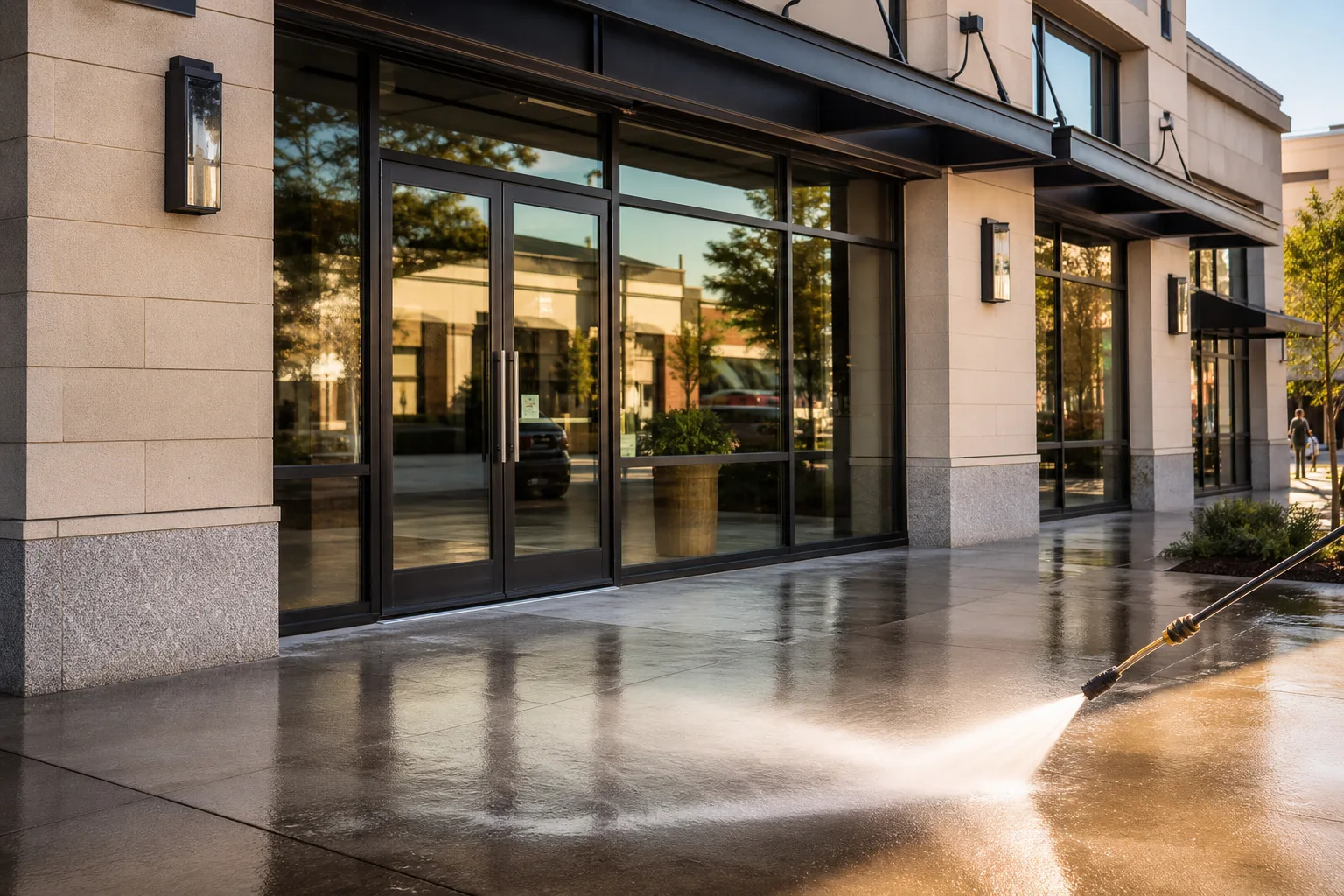
Short answer: restaurant flatwork needs hot water, not more pressure. Grease is what makes an entrance grey, and cold water cannot lift it. Work happens before opening, and dumpster pads are quoted separately.
Every food business in Jacksonville has the same three exterior problems, and all three are grease.
It leaves the kitchen through the exhaust and settles on the roof and the wall below it. It walks out on shoes and builds a dark halo around the entrance. And it collects around the dumpster pad, where it combines with everything else and produces the smell customers notice in the car park before they reach the door.
Cold water does essentially nothing to any of it. Grease needs heat to emulsify before water can carry it away, which is why a nightly hose-down keeps a sidewalk wet without ever making it clean.
Not sure what your property needs?
Send photos. We will tell you what we would do and roughly what it costs — even if the answer is that it can wait.
Why hot water is the whole answer
Grease at ambient temperature is a solid film bonded to the concrete surface. Water at ambient temperature does not dissolve it, so cold pressure washing just pushes it around — which is how a sidewalk ends up with a clean patch surrounded by a grey halo.
Hot water changes the state of the grease. Combined with an emulsifier it breaks into particles that water can carry, and it can then be rinsed and recovered rather than smeared. On a genuinely greasy pad this is the difference between a visible result and a wasted evening.
The other half is drainage. In most municipalities, grease-laden wash water is not permitted to enter the storm system, so on a heavy pad it is contained and recovered. Worth confirming with any contractor who is quoting your dumpster area.
Where grease actually collects on a food site
| Area | Method | Typical frequency |
|---|---|---|
| Entrance sidewalk and apron | Hot water + degreaser | Monthly to quarterly |
| Dumpster pad and corral | Hot water + degreaser, contained | Monthly |
| Drive-through lane | Hot water surface cleaner | Quarterly |
| Patio and outdoor dining | Surface cleaner, food-safe rinse | Monthly in season |
| Building facade | Soft wash | Annually |
| Awnings and canopies | Soft wash, fabric-appropriate | Annually |
| Exhaust-stained wall below hood | Degreaser + soft wash | Twice yearly |
| Signage and menu boards | Hand + soft wash | Quarterly |
Does a clean exterior actually affect health inspections?
Directly, in the areas that fall inside scope. Waste-storage areas are expected to be kept clean and free of accumulation, and a grease-caked dumpster pad attracting pests is the kind of thing that generates a note.
Exterior sidewalks are usually outside inspection scope, but a pad that draws rodents and insects does not stay an exterior problem for long. Monthly attention to the pad is cheap relative to what it prevents.
Two areas are consistently underestimated. The wall below the kitchen exhaust accumulates a greasy film that gets darker every month and is invisible to staff who see it daily. And the patio — outdoor dining concrete absorbs spilled food and drink continuously, and it is where customers sit looking directly at it.
Working around service
The scheduling matters as much as the cleaning.
- Before opening is the standard slot — early morning, finished and dry before the first customer.
- After close works for late-trading venues, though noise ordinances apply in residential-adjacent areas like San Marco, Avondale and the Beaches town centres.
- Never mid-service. A wet entrance during a lunch rush is a slip claim waiting to be filed.
- Dumpster pads on collection day, right after pickup, while the corral is empty.
For multi-unit operators, a recurring schedule across sites prices 15–30% below one-off work and means it happens without anyone having to remember to book it. Most of the restaurant groups we work with run monthly on pads and entrances, quarterly on everything else.
Areas where we do this most
Answers
Restaurant and retail questions
Why does my restaurant sidewalk stay grey no matter how often we hose it?
How often should a dumpster pad be cleaned?
When do you do the work?
Do you handle the wash water?
Can you clean awnings and signage too?
Do you offer recurring contracts for multiple locations?
Related
What people usually book alongside this
Get a real number, not a range
Send a few wide shots plus close-ups of the worst areas and we will price it properly.
Or email hello@jaxpropressurewash.com
What helps us quote fast
- One wide shot of each side that needs cleaning
- Close-ups of the worst staining
- Your address, so we can check the property size
- Roughly when it was last cleaned