
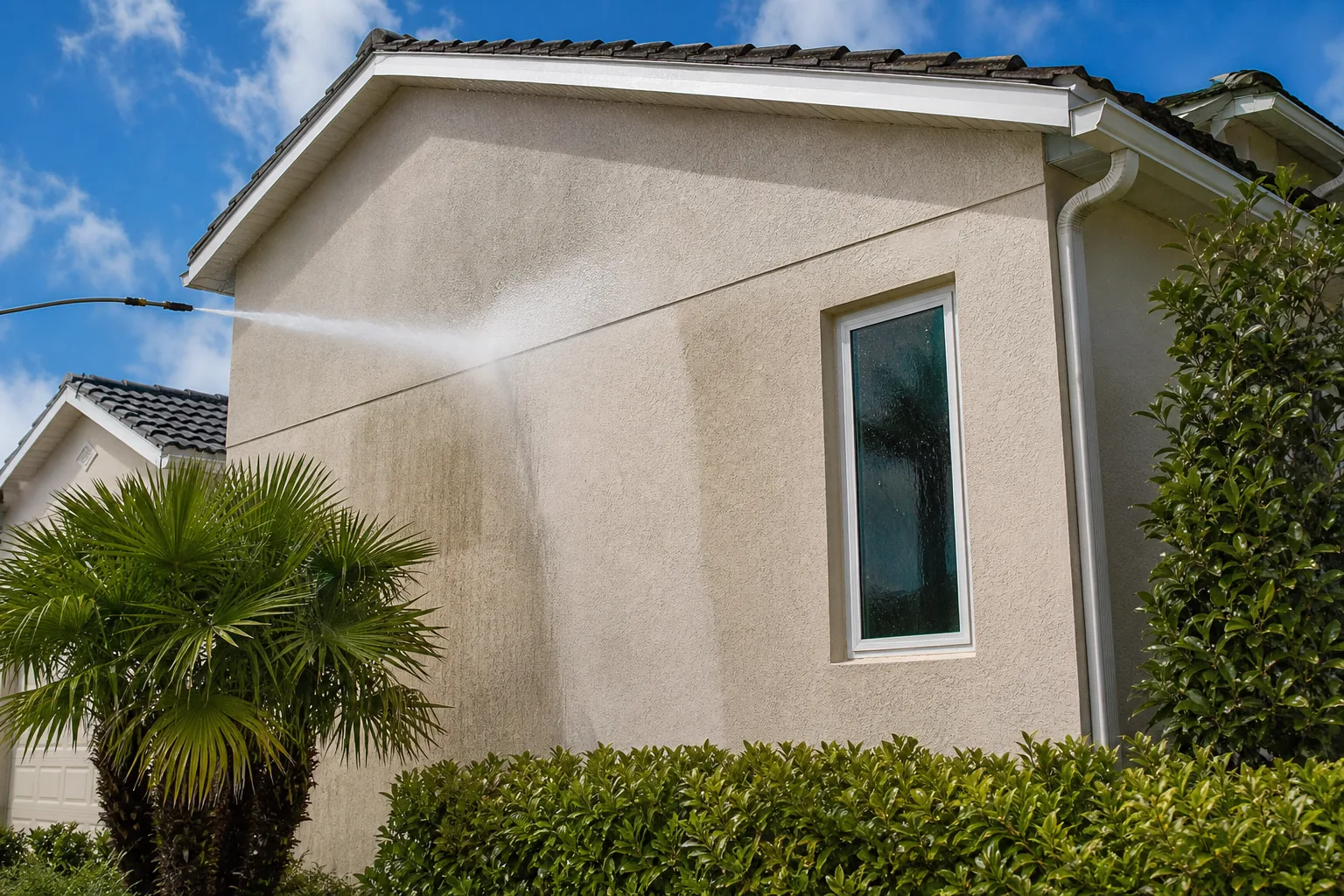
The 20-second version: Pressure washing is cold water at high pressure. Power washing is the same thing heated. Soft washing is low pressure plus a cleaning solution — and it is what your roof, siding, stucco, screens and wood actually need. Only hard flatwork should see high pressure at all.
The pressure-versus-power debate gets a lot of attention and matters far less than people think. The distinction that actually protects your property is the third one, and most companies never bring it up because explaining it takes longer than quoting a wash.
The three methods, side by side
| Pressure washing | Power washing | Soft washing | |
|---|---|---|---|
| Water temperature | Cold | Heated, 140–200°F | Cold |
| Pressure | 1,500–4,000 PSI | 1,500–4,000 PSI | 100–500 PSI |
| What does the work | Force | Force + heat | Cleaning solution + dwell time |
| Kills the organism | No | Partly | Yes |
| Best for | Concrete, brick, hard flatwork | Grease, oil, gum, food residue | Roofs, siding, stucco, screens, wood |
| Wrong for | Anything painted, soft or fragile | The same, plus it costs more | Nothing — it is just slower on hard surfaces |
| Regrowth | Fast — the roots survive | Fast | Slow — the colony is dead |
| Typical residential use | Driveways and walkways | Rarely needed | Most of the house |
Why soft washing is the one that matters
Here is the thing that changes how you think about all of this.
What is on your house is not dirt. The green film on the north wall is algae. The black streaks on the roof are a cyanobacteria called Gloeocapsa magma. The dark patches on shaded concrete are a biofilm. All three are living colonies with root structures anchored into the surface.
Pressure removes what sits on top. It does not kill what is underneath. So a pressure-washed wall looks excellent for about six weeks, and then the colony — which never died — regrows from the roots that were left behind. That is why so many people conclude their house "just gets dirty fast".
Soft washing works the other way round. A dilute sodium hypochlorite solution with a surfactant is applied, left to dwell for five to ten minutes while it kills the organism, then rinsed at roughly garden-hose pressure. The result is not just cleaner — it stays clean two to three times longer, because there is nothing left alive to regrow.
It is also the only method that is safe on most of a house. Which is convenient, because it happens to be the better one anyway.
Which method for which surface
This is the practical answer. Everything above is context for this table.
| Surface | Method we use | Pressure | Why |
|---|---|---|---|
| Asphalt shingle roof | Soft wash | Under 100 PSI | Pressure strips granules permanently. |
| Vinyl or Hardie siding | Soft wash | 100–300 PSI | Force drives water behind the laps. |
| Stucco | Soft wash | 100–300 PSI | Growth lives inside the texture. |
| Painted or chalking surfaces | Soft wash, tested | Under 300 PSI | Failed paint comes off with the algae. |
| Screen enclosure | Soft wash | Under 100 PSI | Mesh tears and pulls off the spline. |
| Wood deck or fence | Low pressure + wood cleaner | 500–1,200 PSI | Higher raises the grain permanently. |
| Concrete driveway | Pressure, surface cleaner | 2,500–3,500 PSI | Genuinely takes it — use the right tool. |
| Pavers | Pressure, reduced | 1,500–2,500 PSI | Joint sand blows out above this. |
| Restaurant grease pad | Power wash (hot) | 2,500–3,500 PSI | Heat is what emulsifies grease. |
| Garage floor with oil | Power wash + degreaser | 2,500–3,000 PSI | Cold water cannot lift oil at all. |
| Solar panels | Deionised water, soft brush | None | Pressure can breach the laminate seal. |
When heated water is genuinely worth paying for
Hot water is not a gimmick — it is just narrower in application than the marketing suggests.
Grease at ambient temperature is a solid film bonded to concrete. Cold water cannot dissolve it, so cold pressure washing just pushes it around, which is how a restaurant sidewalk ends up with a clean patch surrounded by a grey halo. Heat changes the state of the grease so water can carry it away.
So heat earns its cost on: restaurant entrances and dumpster pads, drive-through lanes, garage floors and oil staining, gum removal, and loading docks.
Where heat earns nothing: an ordinary residential driveway with algae and general grime. The cleaning solution and the surface cleaner are doing the work there, and heating the water adds cost without adding result.
Should I be suspicious of a company that only offers one method?
Not necessarily — but you should ask what they intend to do to your roof and siding.
If the answer involves a number above about 500 PSI on either, that is worth pausing on. A company that describes soft washing accurately, without being prompted, is telling you they understand the difference between cleaning a surface and damaging one.
Where the confusion actually comes from
Two terms describe machines. One describes a technique. That mismatch is why the whole subject is muddled.
"Pressure washer" and "power washer" are equipment categories, and the difference between them is a heating element. "Soft washing" is not a machine at all — it is a method, and you can perform it with either machine simply by fitting a low-pressure tip and using the right chemistry.
So a company saying "we are a soft wash company" is telling you about their approach. A company saying "we use a 4,000 PSI commercial unit" is telling you about their hardware, which on its own says nothing about whether they know when to turn it down.
The question that cuts through it is not what equipment somebody owns. It is what number they will run at on your specific surface — and whether they mention dwell time without being prompted.
A quick note on nozzles
If you are doing any of this yourself, the coloured tip on the wand matters as much as the machine setting, and most people have never been told what the colours mean.
- Red (0°) — a pencil-thin jet. It will carve concrete and cut skin. There is essentially no domestic use for it.
- Yellow (15°) — aggressive. Stripping paint, heavy concrete work only.
- Green (25°) — general flatwork. This is the one for a driveway if you are not using a surface cleaner.
- White (40°) — gentle rinsing. Siding, vehicles, general wash-down.
- Black (65°) — the soaping tip. Very low pressure, used to apply solution.
A useful rule: on anything vertical and attached to your house, if you are not using the white or black tip, stop and reconsider.
Answers
Method questions
What is the difference between power washing and pressure washing?
Is power washing the same as pressure washing?
Which one should I use on my house?
Is 1800 PSI enough to power wash a house?
What surfaces should never be pressure washed?
Does hot water clean better than cold?
Related
Where to go next
Not sure which your property needs?
Send a few photos. We will tell you which method each surface should get, and why.