
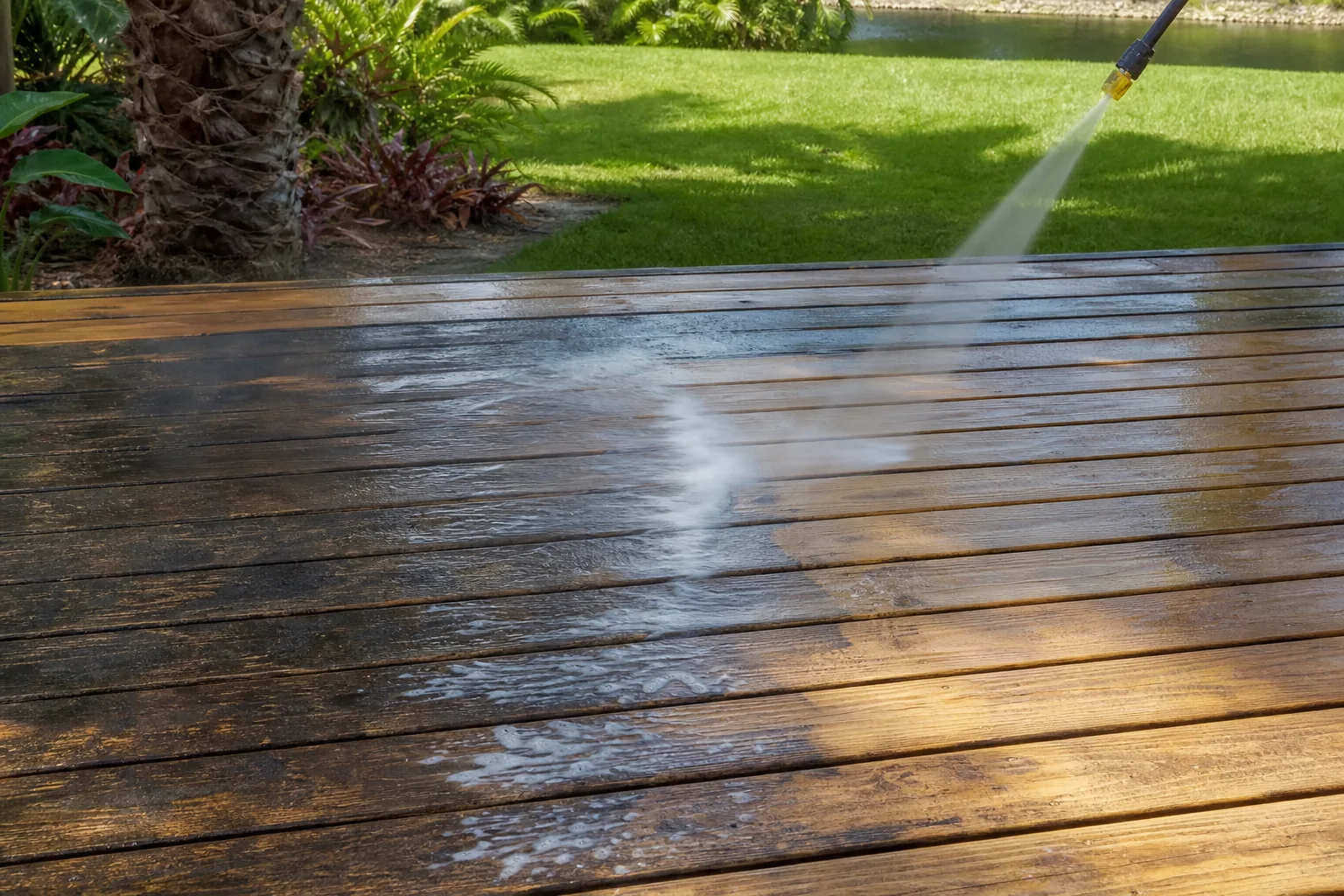
Short answer: docks are cleaned at low pressure with products chosen for the fact that runoff enters the waterway. Typical cost $0.35–$0.75 per square foot, higher than an equivalent deck because of the containment work.
Waterfront property in Jacksonville comes with a surface nobody else has to think about, and almost nobody cleans until it becomes dangerous.
Docks sit in permanently humid air, get splashed daily, and spend part of every tide cycle wet. That produces a biofilm — the same living slick that grows on pool decks, but thicker and faster. On wet timber it is genuinely treacherous, and the people most likely to slip on it are carrying something heavy or wearing bare feet.
The other consideration is the one that makes this different from every other job we do. Whatever comes off the dock enters the St. Johns, the Intracoastal or a tidal creek within seconds. There is no lawn to absorb it and no drain to divert to. That changes the products, the dilution and the method.
Not sure what your property needs?
Send photos. We will tell you what we would do and roughly what it costs — even if the answer is that it can wait.
Runoff, and why it changes the job
On a house we manage runoff by pre-wetting beds and directing water away. On a dock there is nowhere to direct it.
So the approach changes at the front end rather than the back. We use the mildest product that will do the work, at the lowest effective dilution, and we rely more on agitation and dwell than on chemistry. On sections closest to the waterline that means, in practice, mostly hot water and mechanical action.
This is not simply good manners. The St. Johns is an impaired waterway under Florida DEP designation for nutrients in several reaches, and the Lower Basin has a long history of algal bloom problems. Adding unnecessary nutrient load or biocide to it is the kind of thing that eventually becomes somebody's enforcement problem. Doing it properly costs a little more time and no more money.
Will the cleaning harm fish or manatees?
Not with the approach above. Volume and dilution are what matter — a heavily diluted product entering a large moving tidal body disperses almost immediately, which is very different from a concentrated product going into a still creek.
We also watch what is in the water before starting. Manatees use these waterways year-round and congregate in warmer months near docks and outflows. If one is in the immediate area, we wait. It costs us twenty minutes.
What we clean on the water
| Surface | Method we use | Pressure | Why |
|---|---|---|---|
| Pressure-treated dock decking | Low pressure + wood cleaner | 500–1,200 PSI | Same grain-raising risk as any deck. |
| Composite / Trex decking | Soft wash | 500–1,000 PSI | The capped surface scuffs permanently. |
| Concrete seawall cap | Surface cleaner | 2,000–3,000 PSI | Durable, and mostly organic growth. |
| Pilings above waterline | Hand + low pressure | Under 1,000 PSI | Often the slipperiest and least accessible part. |
| Boat lift frame & cradle | Rinse + hand detail | Under 1,000 PSI | Galvanised coating protects against salt corrosion. |
| Boathouse roof | Soft wash | Under 100 PSI | Usually metal — see roof cleaning. |
The section people forget is the waterline band — the strip that is submerged at high tide and exposed at low. It carries the heaviest growth on the whole structure and is only reachable for part of the day.
What dock cleaning costs
Typical Jacksonville range
$0.35–$0.75 per sq ft
Waterfront work is priced higher because runoff control near the St. Johns or the Intracoastal is not optional.
| Job size | Typical range |
|---|---|
| Small private dock (200 sq ft) | $150–$250 |
| Dock + walkway (500 sq ft) | $250–$425 |
| Large dock, boathouse and lift area | $450–$900 |
| What changes the price | Effect |
|---|---|
| Heavy algae at the waterline | +20% to 30% |
| Composite or Trex decking | within base range |
| Boat lift and pilings included | +$100 to $300 |
Ranges reflect typical Jacksonville-area jobs in 2026. They are planning estimates, not quotes — the real number depends on access, buildup severity, and what the surface is actually made of. See how Jacksonville pricing works across every service →
Timing around tides and season
Two scheduling facts that do not apply to any other service we run.
Tide. The waterline band is only workable around low tide, so a dock job is scheduled to the tide table rather than to the morning. On the St. Johns that shifts by roughly 50 minutes a day, which is why we confirm a window rather than a time.
Season. Late spring and early autumn are ideal — warm enough for good results, outside peak boating use, and before the summer growth season really accelerates. Most waterfront owners settle into an annual rhythm, usually just before the weather turns good enough to use the dock properly.
If you have a boat lift, tell us. Lifts, cradles and bunk carpet all collect growth, and it is far easier to address while everything is already set up.
Waterfront areas we cover
Answers
Dock cleaning questions
How much does dock cleaning cost in Jacksonville?
Is cleaning a dock safe for the river?
Why is my dock so slippery?
Can you clean the pilings and boat lift too?
How often should a dock be cleaned?
Do you work around the tide?
Related
What people usually book alongside this
Get a real number, not a range
Send a few wide shots plus close-ups of the worst areas and we will price it properly.
Or email hello@jaxpropressurewash.com
What helps us quote fast
- One wide shot of each side that needs cleaning
- Close-ups of the worst staining
- Your address, so we can check the property size
- Roughly when it was last cleaned