
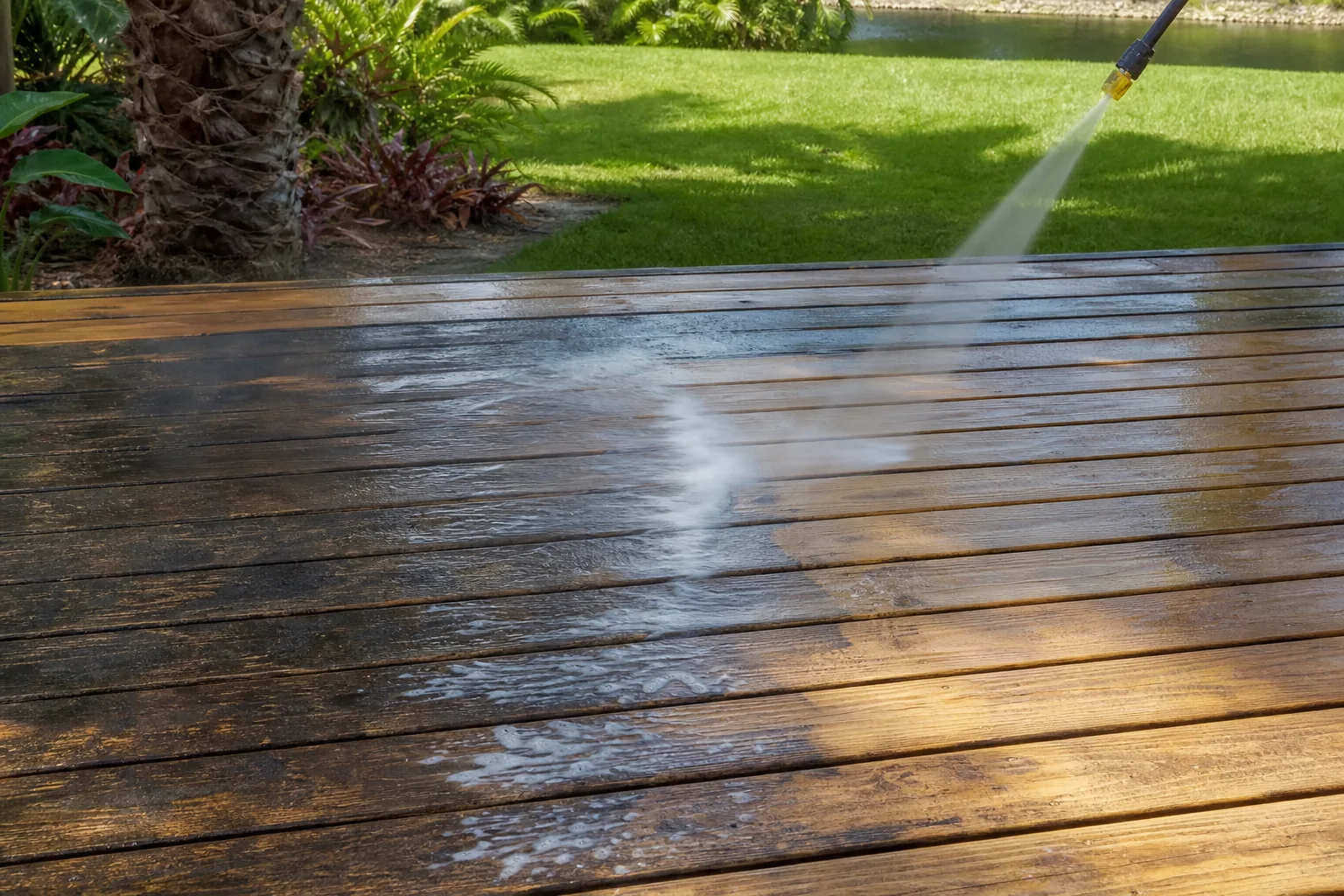
Short answer: decks get cleaned at 500–1,200 PSI with a wood cleaner. If you are staining afterwards, add a brightener — it roughly doubles how long the stain lasts. Typical cost $0.30–$0.65 per square foot.
Decks take more punishment than any other wood on a Florida property. Full sun, driving rain, standing water, furniture rings, sunscreen, spilled drinks and bare feet.
They also show mistakes more obviously than a fence does, because you are looking straight down at the boards and walking on them. A deck cleaned at too high a pressure develops raised, furry grain that catches on bare feet and holds dirt in the fibres. A deck cleaned properly stays smooth and takes stain evenly.
The other thing decks have that fences do not: shade underneath, gaps between boards, and a substructure that stays damp. Most of what makes a deck slippery is growing in those gaps rather than on the surface.
Not sure what your property needs?
Send photos. We will tell you what we would do and roughly what it costs — even if the answer is that it can wait.
How decks are cleaned
The sequence matters more than the equipment.
- Clear and inspect. Furniture and planters off, boards checked for softness, protruding fasteners noted.
- Pre-wet surrounding planting. Decks usually sit right against beds.
- Apply a wood cleaner. Sodium percarbonate based rather than straight bleach on bare wood — it lifts organic growth without the greying effect that heavy chlorine causes on exposed timber.
- Dwell, then agitate gently. A brush on stubborn areas, always along the grain.
- Rinse at low pressure with a wide fan, moving with the boards rather than across them.
- Flush the gaps and the ground beneath, which is where most of the debris ends up.
Why did my last deck cleaning leave it rough and splintery?
Too much pressure, held too close, and probably moved across the grain rather than along it. The jet eroded the soft spring wood and left the harder grain lines standing proud.
It can be improved. A light sanding after the deck has dried fully knocks the raised fibres back, and the next cleaning done correctly will not make it worse. But the wood that was removed is gone.
Composite and Trex decking
Composite is genuinely lower maintenance than wood. It is not maintenance-free, and the failure mode is different.
Older-generation composite — roughly pre-2010, uncapped — is porous enough for mould to grow into the surface rather than just on it. That is why some composite decks develop dark spots that will not scrub off. Newer capped composite has a polymer shell that resists this, but the shell scuffs permanently if you attack it with pressure or an abrasive pad.
So composite gets a soft wash: appropriate solution, dwell time, gentle rinse. Never a pressure wand, never a stiff brush, never a rotary nozzle. Manufacturer warranties on capped boards are commonly voided by exactly that.
What deck cleaning costs
Typical Jacksonville range
$0.3–$0.65 per sq ft
Wood decks are cleaned at low pressure with a wood-safe solution. Blasting a deck is what causes the fuzzy, splintered look people mistake for old wood.
| Job size | Typical range |
|---|---|
| Small deck (200 sq ft) | $125–$200 |
| Standard deck (400 sq ft) | $175–$300 |
| Large multi-level deck (700+ sq ft) | $275–$500 |
| What changes the price | Effect |
|---|---|
| Wood brightener before staining | +$0.20 to $0.40/sq ft |
| Railings and spindles | +$1.50 to $3.00/linear ft |
| Composite instead of wood | −10% to 15% |
Ranges reflect typical Jacksonville-area jobs in 2026. They are planning estimates, not quotes — the real number depends on access, buildup severity, and what the surface is actually made of. See how Jacksonville pricing works across every service →
If you are staining afterwards
Say so when booking, because the prep is different and it decides how long your stain lasts.
Cleaning removes the growth. A brightener — usually oxalic acid based — does two additional things: it neutralises the alkaline cleaner so the wood pH is right for stain, and it opens the grain so the stain can absorb rather than sit on top. It adds $0.20 to $0.40 per square foot.
Then the hard part, which is waiting. Two to three dry days minimum, and longer if it is humid or the deck is shaded. The standard test is to drop water on a board: if it beads, the wood is still too wet or too sealed to take stain. If it soaks in within a few seconds, you are ready.
Staining a deck that is still holding moisture is the single most common reason a stain job fails inside two years.
What we check while we are there
A crew spends an hour or two on their knees on your deck, which is a decent opportunity to notice things.
- Soft or spongy boards — usually where water sits or where a planter has stood.
- Ledger board condition where the deck attaches to the house. This is the connection that fails catastrophically when it fails.
- Protruding or rusted fasteners, which are both a splinter risk and a sign of movement.
- Loose railings and wobbly posts.
- Rot at post bases where they meet the ground or footing.
We do not do carpentry. We do tell you what we found, because you cannot see any of it from a deck chair.
Areas where we do this most
Answers
Deck cleaning questions
What pressure should be used on a wood deck?
How much does deck cleaning cost in Jacksonville?
Can you clean a composite or Trex deck?
How long should I wait before staining?
Will cleaning remove old stain or sealer?
My deck goes slippery in the shade. Will cleaning fix that?
Related
What people usually book alongside this
Get a real number, not a range
Send a few wide shots plus close-ups of the worst areas and we will price it properly.
Or email hello@jaxpropressurewash.com
What helps us quote fast
- One wide shot of each side that needs cleaning
- Close-ups of the worst staining
- Your address, so we can check the property size
- Roughly when it was last cleaned