
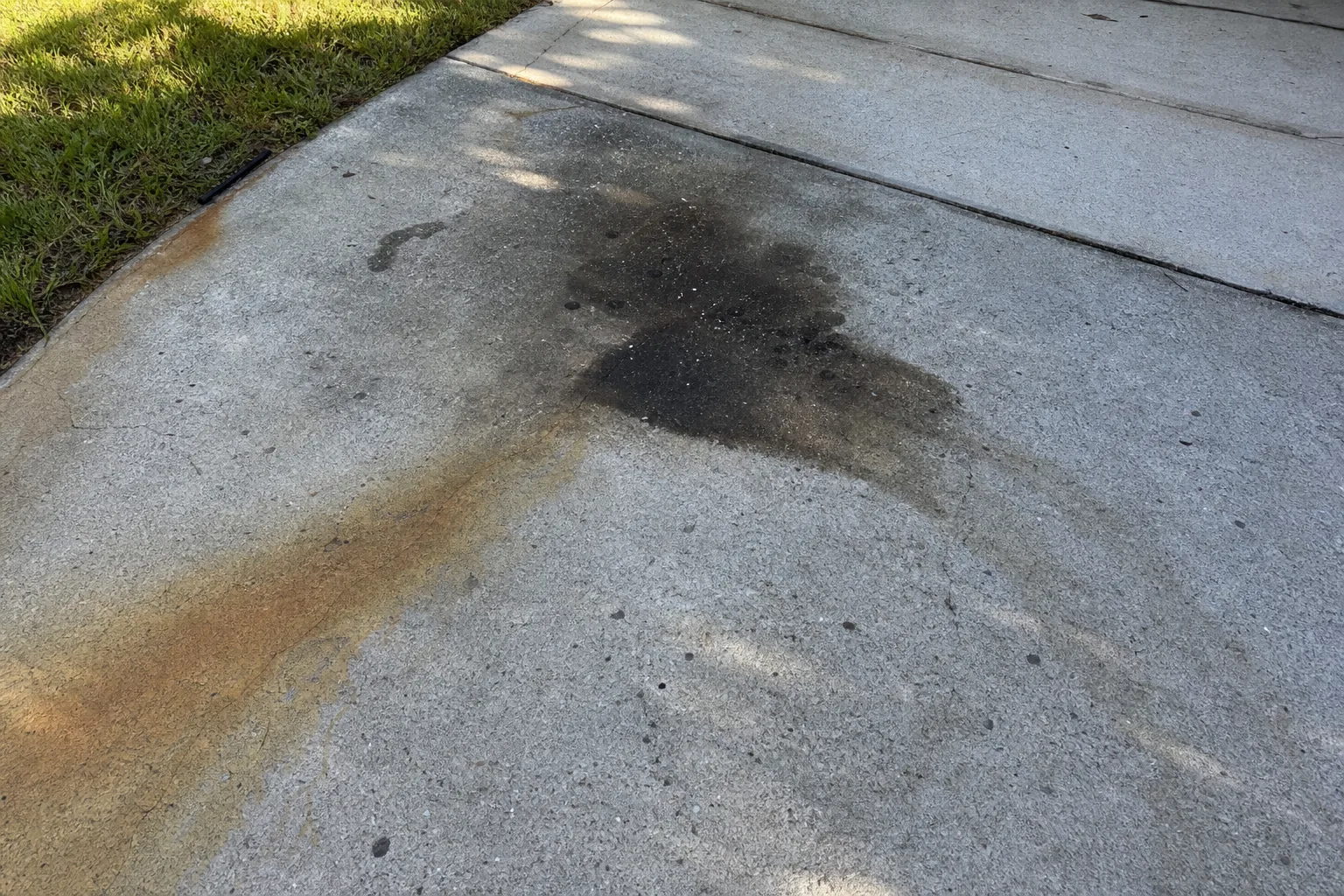
Short answer: how much comes out depends almost entirely on age. Fresh oil lifts nearly completely; oil that has been soaking in for years lightens substantially but usually shadows. Treatment runs $50–$300.
Oil is the stain most often oversold, so here is the honest version.
When oil lands on concrete it does not sit there. Concrete is porous, and oil — being thinner and less viscous than water in some respects — wicks down into the pore structure. The dark patch you can see on the surface is the top of something that extends downward into the slab.
Removing it means pulling the oil back up and out, not scrubbing the top. That is done with an emulsifying degreaser that breaks the oil into particles water can carry, usually with heat, and sometimes with a poultice that draws it upward as it dries. How much comes out depends on how deep it went and how long it has had.
Not sure what your property needs?
Send photos. We will tell you what we would do and roughly what it costs — even if the answer is that it can wait.
What to realistically expect
| Stain age | Type | Realistic result |
|---|---|---|
| Days | Motor oil | 90–100% removal |
| Weeks | Motor oil | 80–95% removal |
| Months | Motor oil | 60–85%, faint shadow likely |
| Years | Motor oil | 40–70%, visible shadow remains |
| Any age | Transmission fluid | Harder than motor oil — dyed and more penetrating |
| Any age | Hydraulic fluid | Similar to transmission fluid |
| Any age | Cooking grease | Removes well with heat |
| Any age | Oil on sealed concrete | Usually excellent, it never reached the slab |
One detail that surprises people: a stain often looks worse immediately after treatment before it looks better. Drawing oil out of the pores brings some of it back to the surface, so a fresh-looking dark patch mid-process is the treatment working, not failing. The final result shows once it has dried fully, usually 24 to 48 hours later.
How oil is treated
- 01
Assess
Age, type and whether the concrete is sealed. This decides what is realistic before any money changes hands.
- 02
Degrease
An emulsifying degreaser applied and worked in, with enough dwell to reach below the surface.
- 03
Heat where it helps
Hot water thins the oil and speeds emulsification. It is the difference-maker on older stains.
- 04
Agitate and extract
Mechanical agitation, then rinse and recover so the oil is removed rather than spread.
- 05
Repeat if needed
Deep stains take two or three cycles. One pass on a four-year-old stain is not a serious attempt.
- 06
Assess again once dry
The real result is only visible after 24–48 hours of drying.
What oil stain treatment costs
Typical Jacksonville range
$50–$300
Honest expectation: fresh oil comes out, four-year-old transmission fluid lightens substantially but usually leaves a shadow.
| Job size | Typical range |
|---|---|
| Single fresh drip spot | $50–$100 |
| Garage apron with multiple old stains | $125–$250 |
| Commercial pad or drive-through lane | $175–$300 |
| What changes the price | Effect |
|---|---|
| Hot-water treatment required | +$40 to $100 |
| Stain older than 2 years | improvement, not removal — quoted honestly |
Ranges reflect typical Jacksonville-area jobs in 2026. They are planning estimates, not quotes — the real number depends on access, buildup severity, and what the surface is actually made of. See how Jacksonville pricing works across every service →
What to do before we arrive
If the spill is recent, what you do in the first hour matters more than what we do next week.
- Absorb, do not spread. Cat litter, sawdust or an absorbent granule, left to sit and then swept up. Do not hose it — that drives it deeper and spreads the edge.
- Do not use a degreaser and then leave it. A degreaser that is applied and allowed to dry re-deposits the oil it lifted.
- Do not use a wire brush. It scars the concrete and gives the oil more surface area to sit in.
- Fix the leak first. Treating a driveway under a car that is still dripping is money spent on a countdown.
Should I seal the driveway afterwards?
If the area sees regular vehicle traffic, it is worth it. A penetrating sealer will not stop a leak, but it dramatically slows how fast oil reaches the pore structure — which turns a future spill from a permanent stain into a wipe-up.
It goes on properly dry concrete, so it is a separate visit a few days later rather than the same afternoon.
Areas where we do this most
Answers
Oil stain questions
Can you get old oil stains out of concrete?
Why does my oil stain look worse right after treatment?
How much does oil stain removal cost?
Is transmission fluid harder to remove than motor oil?
What should I do the moment oil spills?
Will pressure washing alone remove oil?
Related
What people usually book alongside this
Get a real number, not a range
Send a few wide shots plus close-ups of the worst areas and we will price it properly.
Or email hello@jaxpropressurewash.com
What helps us quote fast
- One wide shot of each side that needs cleaning
- Close-ups of the worst staining
- Your address, so we can check the property size
- Roughly when it was last cleaned