
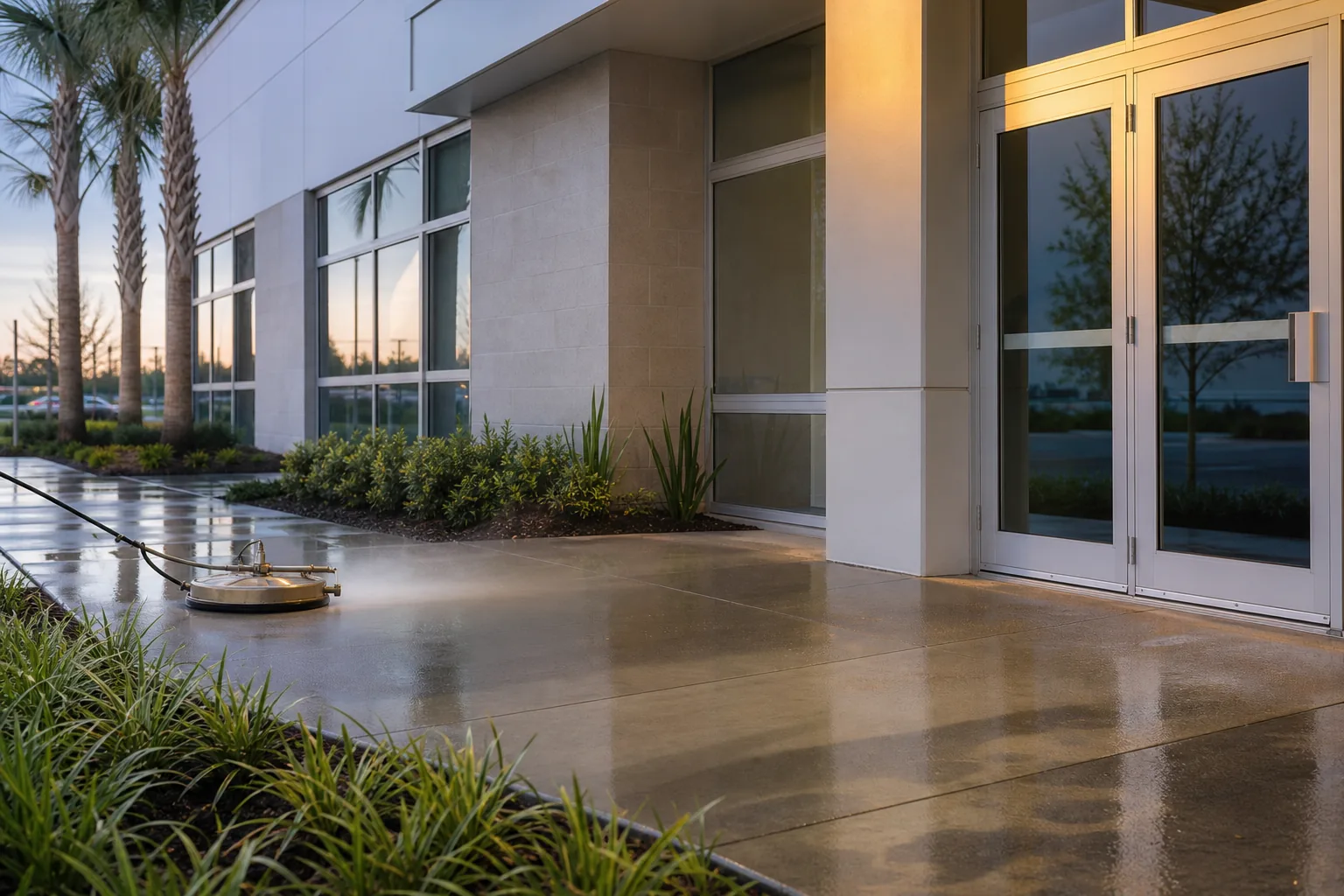
What commercial buyers actually need: a current certificate of insurance, a scope specific enough to compare against other bids, work scheduled around operations rather than around us, and runoff handled the way the rules require. Everything below is built around those four.
Commercial exterior cleaning goes wrong for administrative reasons far more often than technical ones. A contractor turns up on the wrong day, or the COI expired three months ago and nobody noticed, or the bid said "clean common areas" and it turns out that never included the monument signs.
None of that is about how well someone can clean concrete.
Who we work with
Five kinds of commercial customer, five different jobs
What gets cleaned on a commercial property
| Area | Method | Typical frequency |
|---|---|---|
| Entrance walkways and aprons | Surface cleaner | Monthly to quarterly |
| Building facade | Soft wash | Annually |
| Breezeways and stairwells | Surface cleaner + hand work | Quarterly |
| Dumpster pads and corrals | Hot water + degreaser, contained | Monthly |
| Drive-through lanes | Hot water surface cleaner | Quarterly |
| Parking areas and garage decks | Surface cleaner + reclamation | Every 6–12 months |
| Awnings, canopies and signage | Soft wash | Annually |
| Loading docks and service corridors | Hot water | Quarterly |
| Pool decks and amenity areas | Surface-matched | Annually or seasonally |
| Gutters across whole buildings | Clear + brighten | Twice yearly |
Which item gives commercial property the most visible return?
The entrance, without much competition. It is the smallest area on the list and the one every customer, resident and prospective tenant walks across. A grey entrance apron reads as neglect before anyone has met your staff or seen the interior.
For multi-family specifically, breezeway concrete is the equivalent. Residents stop noticing it because they walk it daily; every prospect on a tour notices it immediately.
Insurance, runoff and the parts that create liability
Three things separate a commercial contractor from a residential one, and none of them are equipment.
Certificates of insurance
General liability, issued to the property before work starts, with whatever additional insured wording your lease or governing documents require. We track renewals and send them before expiry rather than waiting to be chased — a lapsed COI on file is a problem that surfaces at the worst possible moment.
Stormwater and runoff
This is where most commercial exterior cleaning quietly breaks the rules. Wash water carrying grease, hydrocarbons or heavy metals generally cannot be discharged into a storm drain, and in Jacksonville most of that system reaches the St. Johns or a tributary. On dumpster pads, drive-throughs and covered parking decks, runoff is contained and recovered.
It is a fair question to put to every contractor bidding your property. If the answer is vague, you have learned something useful.
Slip liability while we work
Wet concrete is the risk nobody quotes for. Work is sectioned so a route always stays open, signage and cones go out, and amenity areas are done on the lowest-use days. On garage decks, wet concrete under artificial lighting is genuinely difficult to see, so those are always coned.
How commercial work is priced
General flatwork
$0.1–$0.25 per sq ft
Minimum charge $350 per visit
Grease-heavy areas, stairwells and specialty surfaces are quoted as separate lines, because they are separate work.
- Recurring contracts price 15–30% below one-time rates.
- After-hours and overnight work adds roughly 20%.
- Grease-heavy areas (drive-throughs, dumpster pads) are quoted separately from general flatwork.
Every commercial proposal is itemised by asset with measured square footage shown. That is not a courtesy — it is the only way three bids can be compared against each other, and it is the single most common thing missing from the quotes our customers show us.
If you already have bids in hand, send them across. We will tell you what they do and do not include, which is useful whether or not you end up using us.
Why recurring costs less than reactive
The arithmetic is straightforward and it is worth putting in front of whoever approves the budget.
A property cleaned quarterly never develops established growth, so each visit is faster and uses less material — which is why recurring rates land 15 to 30 percent below one-off pricing. A property cleaned only when someone complains has always had months to build up, so every visit is a heavy clean at full rate.
The second argument is the one that actually moves boards and owners: organic growth on a walkway or pool deck is a slip liability, and algae holding moisture against timber shortens its life. On those assets, cleaning is maintenance rather than presentation — which changes which budget line it comes out of.
Commercial corridors we work in
Before & after
Commercial entrances that look open-ready
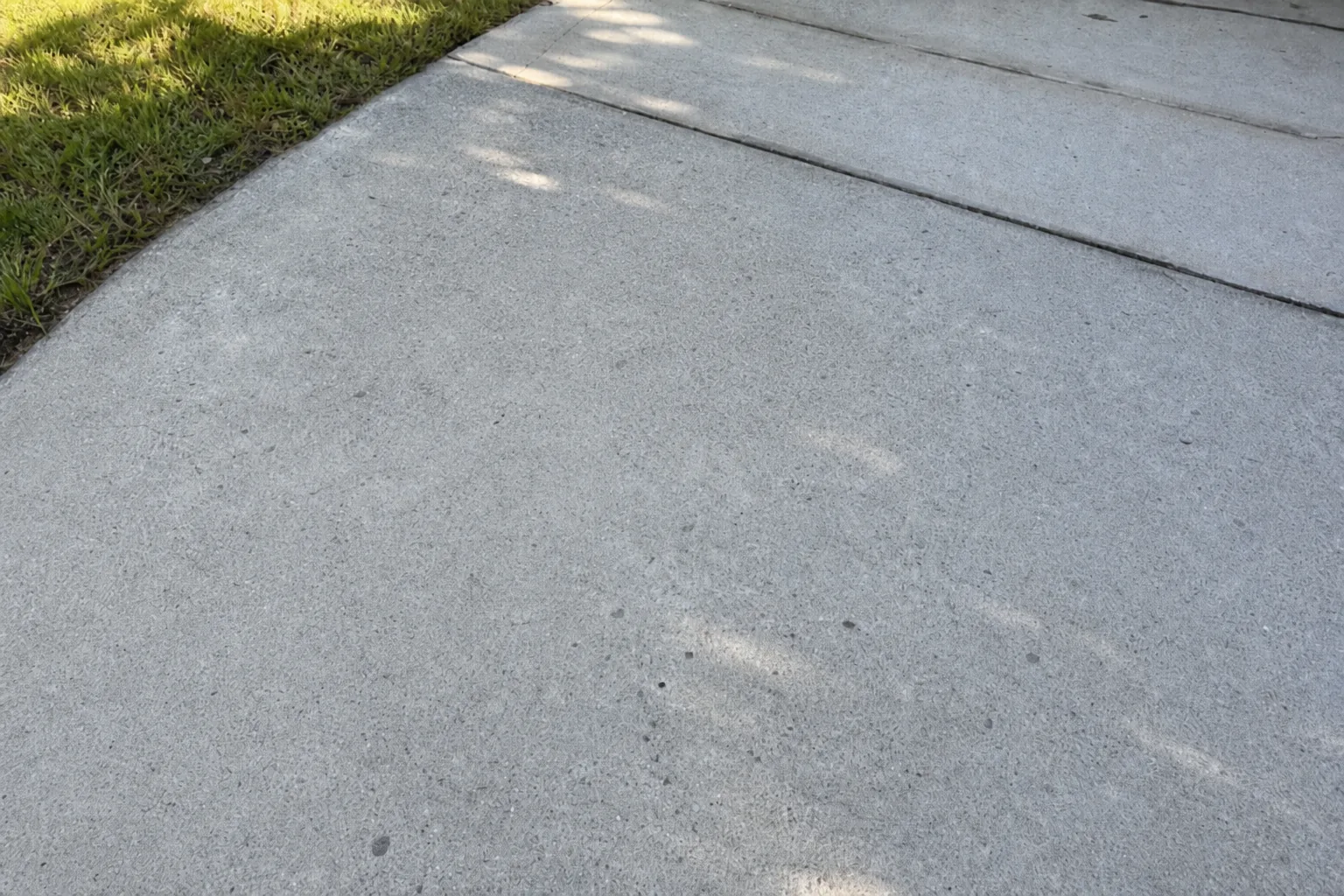
Foot-traffic grime and organic film come off flatwork without striping the concrete.
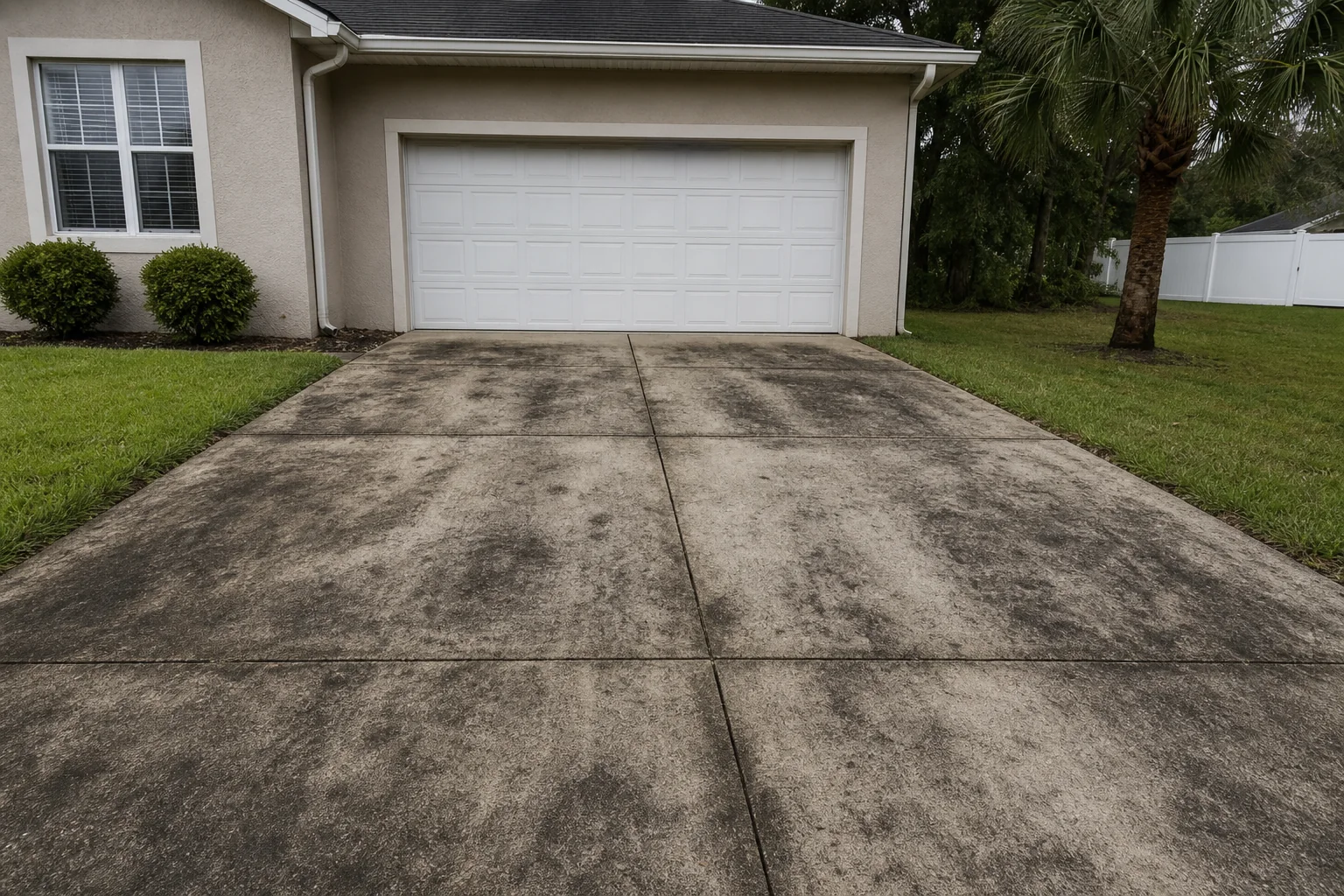
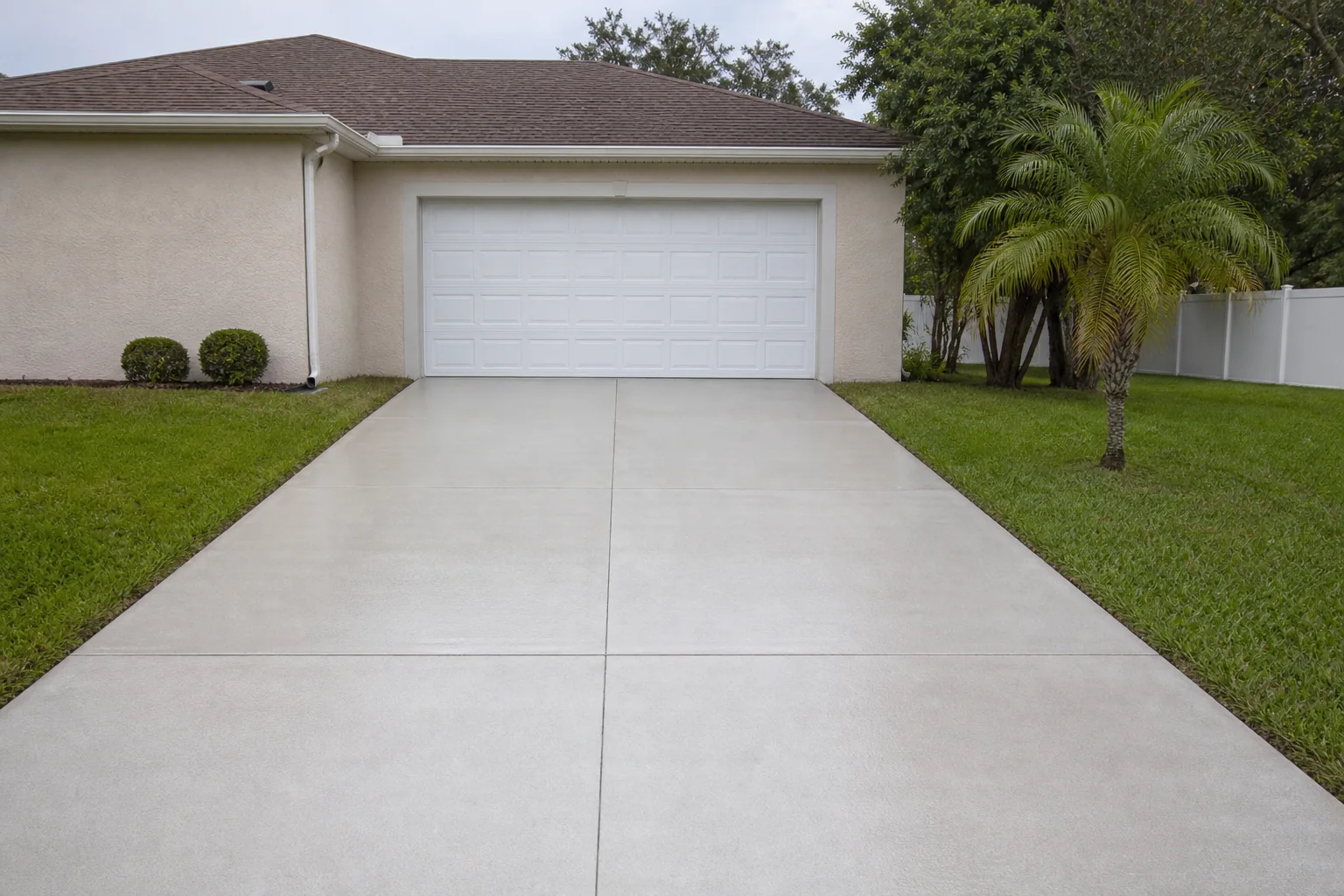
Entry sidewalk surface cleaning
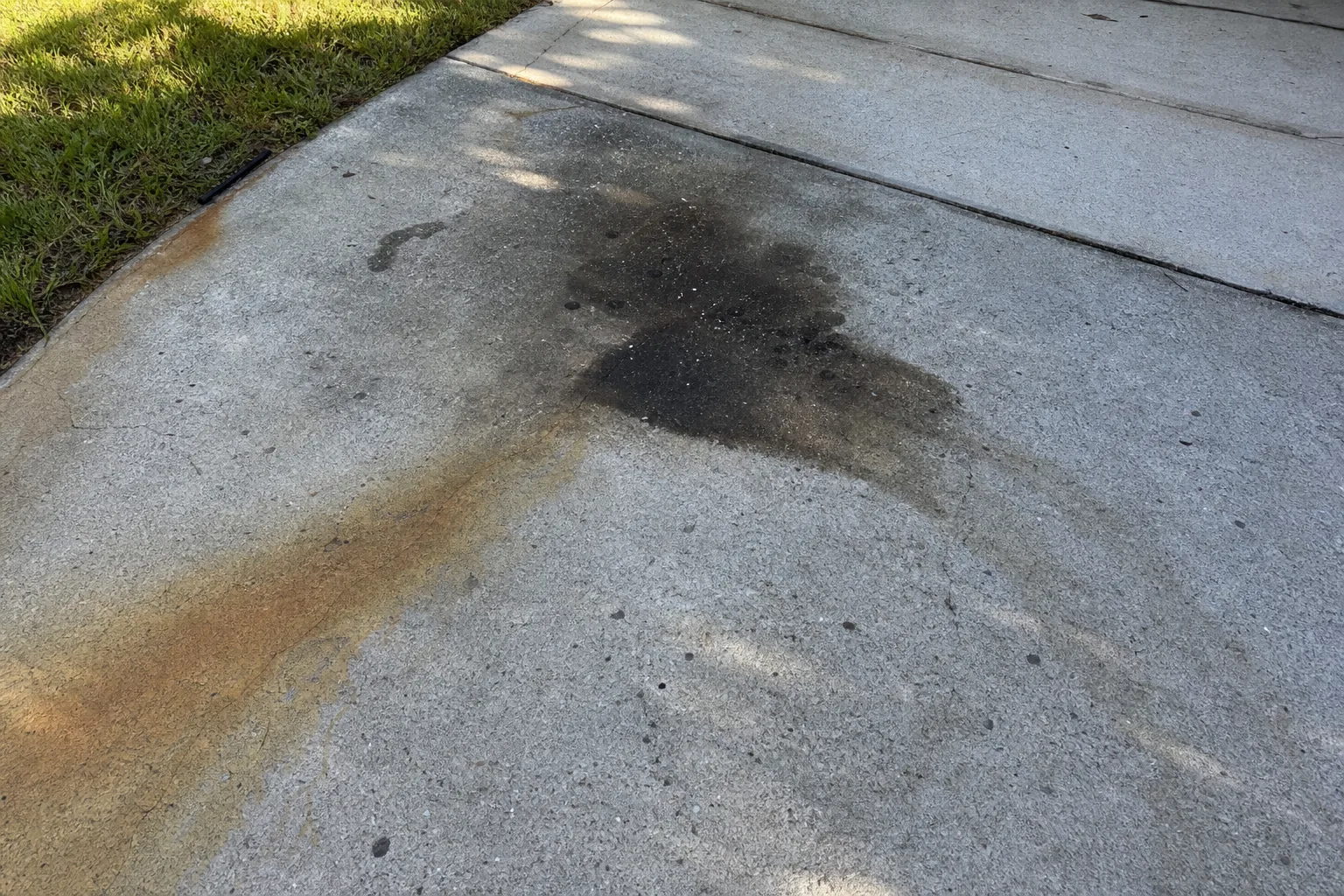
Dumpster-pad and grease-prone concrete
Answers
Commercial questions
How much does commercial pressure washing cost in Jacksonville?
Can you work outside business hours?
Are you insured, and can you name our property?
What happens to the wash water?
Do you offer recurring maintenance contracts?
How much notice do you need?
Related
What people usually book alongside this
Upload site photos for a commercial estimate
Include operating hours, water access, and close-ups of grease, gum, or irrigation stains so we can plan heat, chemistry, and traffic control.
Or email hello@jaxpropressurewash.com
What helps us quote fast
- One wide shot of each side that needs cleaning
- Close-ups of the worst staining
- Your address, so we can check the property size
- Roughly when it was last cleaned