
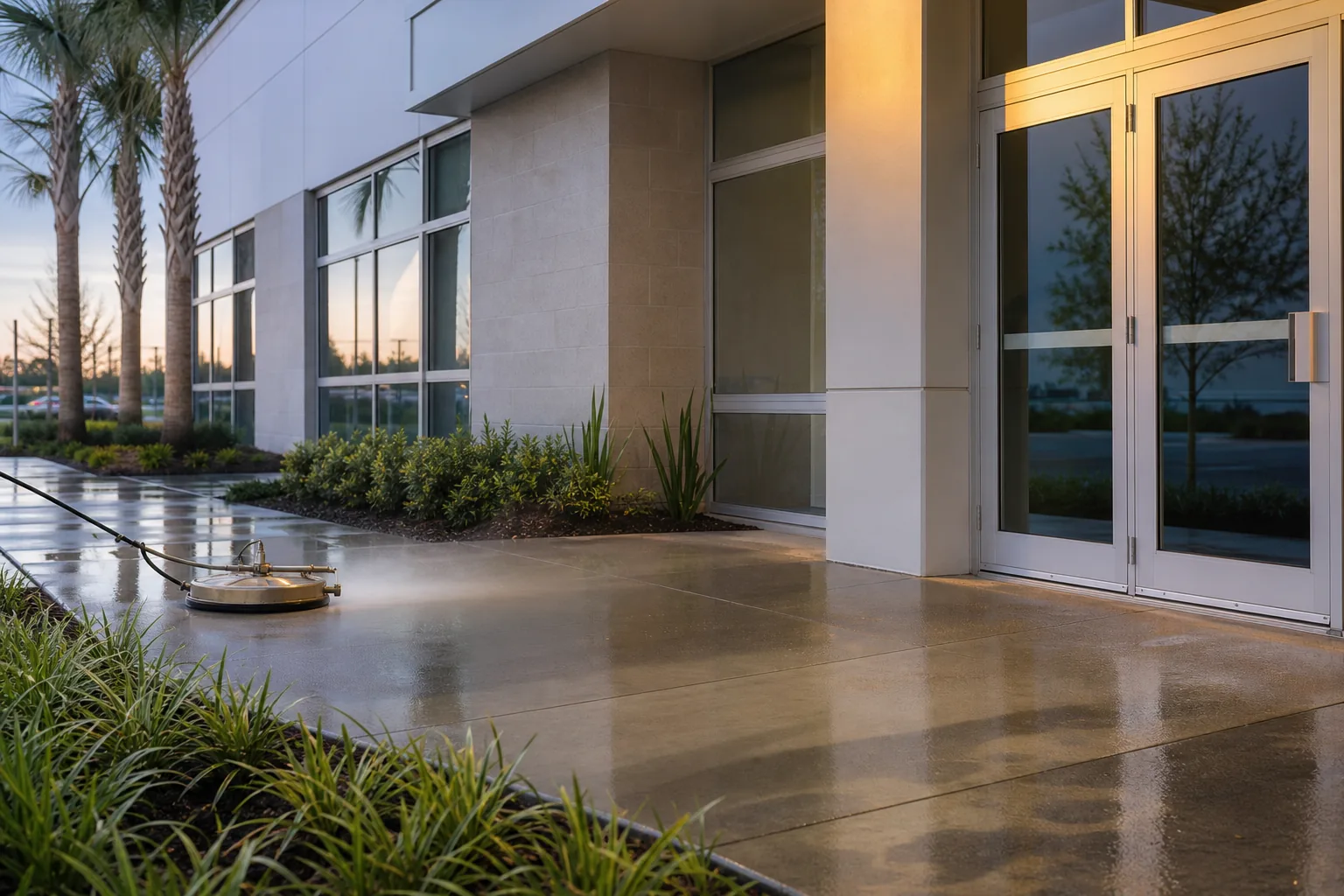
Short answer: construction residue is chemical, not organic, so it needs different products from a normal wash. Every month it stays on makes it harder to remove. Quoted per property.
Construction leaves a specific and unusual set of marks, and none of them respond to the method that cleans algae off a three-year-old house.
Mortar splash, stucco splatter, thinset, grout haze, paint overspray, adhesive, silicone smears, tape residue, and a fine cementitious dust that settles over everything and then gets rained on. These are chemical and mechanical bonds, not biological growth, so the biocide-and-dwell approach that works on a normal house wash does very little.
The other difference is urgency. Organic growth stays roughly as removable as it was. Construction residue does the opposite — cementitious material continues curing, and paint and adhesive keep hardening. What lifts easily in the first month can need aggressive treatment by year two, and by year three some of it is permanent.
Not sure what your property needs?
Send photos. We will tell you what we would do and roughly what it costs — even if the answer is that it can wait.
What we remove
| Residue | Where it shows up | How it comes off |
|---|---|---|
| Stucco splatter | Driveways, walkways, windows | Acidic treatment, timing-critical |
| Mortar haze | Brick, pavers, stone | Masonry cleaner, never straight pressure |
| Grout haze | Tile, pavers, entries | Specific haze remover |
| Paint overspray | Concrete, glass, fixtures | Solvent or mechanical depending on substrate |
| Adhesive and tape residue | Windows, doors, trim | Solvent, worked by hand |
| Silicone smears | Glass and frames | Mechanical — the most tedious item on the list |
| Cementitious dust film | Everything | Full wash, usually the largest area |
| Efflorescence on new masonry | Brick, block, pavers | Efflorescence remover; may recur while curing |
| Tyre and machinery marks | Driveways, aprons | Degreaser plus surface cleaner |
Why timing matters so much
This is the part worth acting on.
Month one: most residues lift with the correct product and moderate effort. Stucco splatter in particular is dramatically easier before it fully cures.
Months two to six: cementitious material has hardened. It still comes off, but it needs stronger treatment and more passes, which costs more.
Year one and beyond: some of it is now effectively part of the surface. Removal risks damaging the substrate more than the residue does, and at that point the honest advice is sometimes to leave it.
For homeowners in the new-build corridors around Nocatee, St. Johns and Yulee: if your home was handed over in the last year and there are white splatter marks on the driveway or haze on the pavers, that is worth addressing this season rather than next.
The builder said the driveway marks will fade. Will they?
Some will. Fine cementitious dust weathers off within a few months of exposure, and light efflorescence usually settles down within the first year or two as the masonry finishes curing.
Stucco splatter, mortar drops, paint overspray and adhesive will not. They are still there in year three, they are harder to remove, and by then the builder's warranty conversation has closed. Send a photo — we will tell you honestly which category yours falls into.
Builder and homeowner scopes
Two different jobs with two different buyers.
For builders and GCs, this is punch-list work on a fixed handover date. Driveway, walkways, patio, all elevations, windows, and the entry — done to a standard that survives a walkthrough. We schedule to the CO date and work around the trades still finishing, which in practice means being flexible about the running order.
For homeowners, it is usually a discovery a few months after moving in — the marks that were invisible against a muddy lot become obvious once the sod is down and the landscaping is in. That scope is narrower and priced accordingly.
Either way it is quoted per property rather than from a rate card, because the residue mix varies enormously between builds.
New-build corridors we work in
Answers
Post-construction questions
How soon after construction should the exterior be cleaned?
Can you remove stucco splatter from a driveway?
What is the white haze on my new pavers?
Do you work with builders on a schedule?
The builder said the marks will weather away. Is that true?
How is post-construction cleanup priced?
Related
What people usually book alongside this
Get a real number, not a range
Send a few wide shots plus close-ups of the worst areas and we will price it properly.
Or email hello@jaxpropressurewash.com
What helps us quote fast
- One wide shot of each side that needs cleaning
- Close-ups of the worst staining
- Your address, so we can check the property size
- Roughly when it was last cleaned