
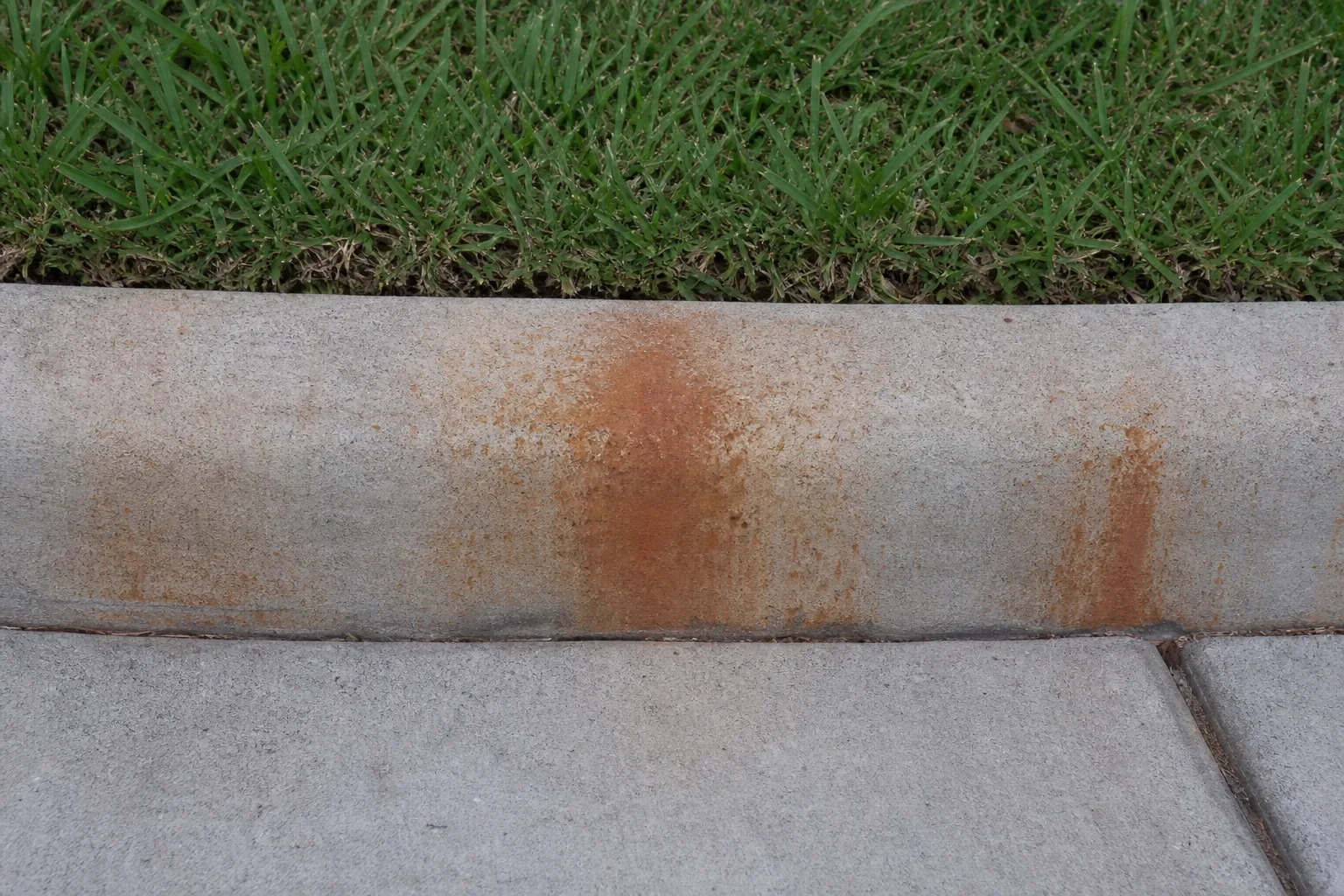
Short answer: rust is chemically bonded into the concrete, so pressure does nothing. It takes an acid-based treatment. Typical cost $75–$450 — and adjusting the sprinkler head matters as much as the treatment.
This is the most misdiagnosed exterior problem in North Florida, and the pattern gives it away every time: curved orange arcs, always the same shape, always centred on a sprinkler head.
What has happened is straightforward. Irrigation water carries dissolved iron — heavily so on a well, and in measurable amounts even on municipal supply. Every time the head sweeps across the concrete it deposits a trace. The water evaporates, the iron oxidises, and it bonds into the porous surface of the slab.
It is now part of the concrete, not sitting on it. That is why homeowners who buy a bigger pressure washer are always disappointed. Pressure removes what is on a surface; this needs a chemical reaction to lift out what is in it.
Not sure what your property needs?
Send photos. We will tell you what we would do and roughly what it costs — even if the answer is that it can wait.
Why pressure does nothing
Concrete looks solid and is not. It is full of interconnected pores, and dissolved iron travels into them with the water before oxidising in place.
A pressure washer, even a commercial one, only acts on the top surface. It will clean the algae and film off around the stain — which frequently makes the orange look worse, because you have brightened everything except the rust.
The treatment is an acid, usually oxalic or a blended rust remover, which converts the iron oxide into a soluble compound that can then be rinsed away. It needs correct dwell time, correct dilution and thorough neutralising afterwards. Too strong or left too long and it etches the concrete, which trades an orange stain for a permanently rough patch. This is the part that goes wrong when people try it themselves with a hardware-store product.
Can I just use a rust remover from the hardware store?
You can, and on a small isolated spot it sometimes works. Two things go wrong at scale.
The first is etching — leaving acid on too long, or mixing it too strong, damages the concrete surface permanently. The second is uneven coverage, which leaves a clean patch surrounded by stained concrete and looks worse than the original problem. On a full driveway, even application and proper neutralising are most of the skill.
Not all orange stains are the same
| What you see | Likely cause | Realistic outcome |
|---|---|---|
| Curved arcs, repeating pattern | Irrigation iron from a sprinkler head | Removes very well |
| Heavy, dark orange across a wide area | Well water, high iron content | Removes well, may need two applications |
| Reddish patches near beds | Fertilizer iron burn | Removes well |
| Streaks running down siding or stucco | Rust bleeding from a fastener or fixture | Stain removes; returns unless the fastener is dealt with |
| Rust under a metal railing or furniture | Direct contact corrosion | Usually removes; seal or lift the item afterwards |
| Orange with a pitted, rough texture | Acid or long-term corrosion that has etched the slab | Colour improves; the texture damage is permanent |
What rust removal costs
Typical Jacksonville range
$75–$450
Charged separately from washing because it is a chemical treatment, not a pressure job. Fixing the sprinkler head matters as much as removing the stain.
| Job size | Typical range |
|---|---|
| Isolated stains on one driveway edge | $75–$175 |
| Full driveway with widespread orange staining | $175–$350 |
| Rust bleed on siding, stucco or a pool deck | $125–$450 |
| What changes the price | Effect |
|---|---|
| Well water (iron-heavy, deeply set) | +25% to 50% |
| Fertilizer burn on concrete | usually within base range |
| Battery-acid or fastener rust (permanent etch) | assessed first — may not be removable |
Ranges reflect typical Jacksonville-area jobs in 2026. They are planning estimates, not quotes — the real number depends on access, buildup severity, and what the surface is actually made of. See how Jacksonville pricing works across every service →
Stopping it coming back
Removing the stain without fixing the cause means paying for the same job again next year. Five things genuinely work:
- Adjust or shield the sprinkler head so its arc stops short of the concrete. This alone solves most cases and costs nothing.
- Change the spray pattern — a head throwing across a driveway can usually be swapped for one that does not.
- Fit an iron filter on a well system. It is the real fix if you are on a well, and it helps your fixtures and laundry too.
- Water at night or early morning so droplets do not bake dry on hot concrete.
- Seal the concrete after treatment. A penetrating sealer reduces how deeply future deposits can get in.
Out in Middleburg, Yulee and the rural parts of the Northside, where wells are common, this is the defining exterior problem — worth solving at the source rather than treating annually.
What cannot be removed
- Etched concrete. Where acid or long-term corrosion has eaten into the slab, the colour improves but the texture damage stays.
- Rust from a fastener still in place. The stain comes off and comes straight back. The fastener has to be sealed, replaced or coated.
- Battery acid marks. These are chemical burns into the concrete, not stains.
- Stains under a failing sealer. The sealer has to come off before anything can reach the concrete underneath.
- Rust on unsealed natural stone. Treatable, but acid and stone are a risky combination — we test first and sometimes advise against it.
Well-water areas where rust is the main problem
Answers
Rust stain questions
Why does my driveway have orange stains?
Can pressure washing remove rust stains?
How much does rust stain removal cost?
Will the rust come back?
Is rust removal safe for my concrete?
Can you remove rust stains from my house siding?
Related
What people usually book alongside this
Get a real number, not a range
Send a few wide shots plus close-ups of the worst areas and we will price it properly.
Or email hello@jaxpropressurewash.com
What helps us quote fast
- One wide shot of each side that needs cleaning
- Close-ups of the worst staining
- Your address, so we can check the property size
- Roughly when it was last cleaned