
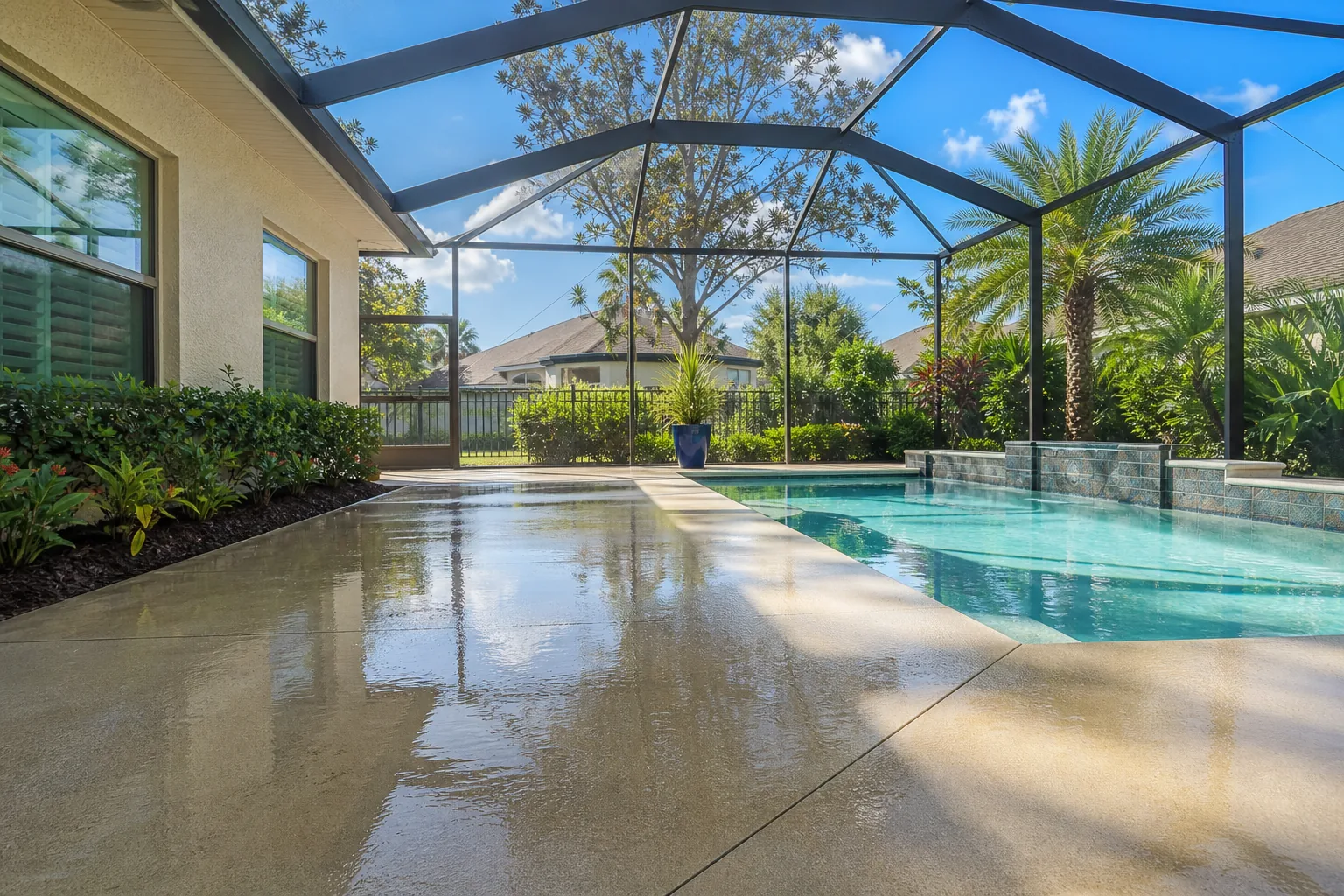
Short answer: the material decides everything. Cool deck and Kool Deck coatings will not survive above about 1,200 PSI, travertine etches, and pavers lose joint sand. Typical cost $150–$425.
Pool decks are where we see more avoidable damage than any other residential surface, and it is almost always the same story: someone cleaned it at driveway pressure.
The problem is that pool decks look like concrete. A textured cool-deck coating is only a few millimetres thick, sprayed over a slab, and it is designed to stay cool underfoot rather than to resist a 3,000 PSI jet. Once it is gone in patches, it cannot be spot-repaired invisibly — the whole deck has to be recoated.
There is also the water itself. Cleaning solution running into a pool changes the chemistry immediately, and on a saltwater system it is worse than on chlorine. Managing where the runoff goes is not an afterthought here.
Not sure what your property needs?
Send photos. We will tell you what we would do and roughly what it costs — even if the answer is that it can wait.
What your deck is made of decides everything
| Surface | Method we use | Pressure | Why |
|---|---|---|---|
| Cool deck / Kool Deck | Low pressure + solution | 800–1,200 PSI | A thin sprayed coating. Above this it strips in patches. |
| Travertine | Low pressure + solution | 800–1,400 PSI | Porous natural stone that etches and pits. |
| Marcite / plaster deck | Chemical, gentle rinse | Under 1,000 PSI | Soft and easily scarred. |
| Concrete pavers | Surface cleaner, reduced | 1,500–2,500 PSI | Joint sand blows out above this. |
| Stamped concrete | Reduced pressure | 1,200–2,000 PSI | Colour sits in the top layer only. |
| Plain poured concrete | Surface cleaner | 2,500–3,000 PSI | The only pool-deck surface that takes full pressure. |
My deck already has bare patches. Can cleaning fix that?
No — and this is worth being blunt about. Where a coating has been stripped away, cleaning makes the contrast more visible, not less, because the surrounding coated area comes back to its original colour.
We will show you where it has already failed before starting so it is not a surprise afterwards. Recoating is a resurfacing job, not a cleaning one.
If you do not know which you have, send a close-up photo. The difference is usually obvious to someone who works on them daily, and getting it wrong is expensive.
Protecting the pool itself
Four things happen before any solution goes down.
- The pool gets covered where the deck runs right to the coping, or the runoff gets physically diverted away from the water line.
- Equipment is checked — pumps, heaters, salt cells and automation panels are identified and shielded.
- Runoff is directed to a drain or lawn area, not into the skimmer.
- You get told to check your chemistry the next day regardless, because some carry-over is realistic on a deck that drains toward the pool.
On screened lanais the enclosure needs its own approach entirely — the mesh will not take deck pressure. That is screen enclosure cleaning, and it is normally booked at the same time because the setup is already in place.
What pool deck cleaning costs
Typical Jacksonville range
$150–$425
Roughly $0.2–$0.4 per sq ft
Travertine, marcite, cool-deck and Kool Deck coatings each have a different pressure ceiling, so the surface sets the price as much as the size does.
| Job size | Typical range |
|---|---|
| Small deck / patio (up to 400 sq ft) | $150–$250 |
| Standard pool deck (600–900 sq ft) | $200–$350 |
| Large deck + covered lanai (1,200+ sq ft) | $300–$425 |
| What changes the price | Effect |
|---|---|
| Cool-deck or coated surface (lower pressure, slower) | +15% to 25% |
| Travertine or natural stone | +20% to 30% |
| Booked with the screen enclosure | −$50 to $100 |
Ranges reflect typical Jacksonville-area jobs in 2026. They are planning estimates, not quotes — the real number depends on access, buildup severity, and what the surface is actually made of. See how Jacksonville pricing works across every service →
Why pool decks get slippery, and what actually fixes it
A slick pool deck is not usually dirt. It is a biofilm — a thin, living layer of algae and bacteria that thrives in the constant damp around a pool, especially on shaded sides and under screen enclosures.
Rinsing it with water alone makes it more slippery for a while, because you are wetting the film rather than removing it. It takes a biocide to kill the organism and a proper clean to lift the residue.
Two follow-ups worth knowing. If a deck goes slick again within a couple of months, the cause is usually poor drainage or dense shade holding moisture — worth solving at the source. And if the surface has a coating that has worn smooth, cleaning restores appearance without restoring texture; that needs recoating.
Areas where we do this most
Answers
Pool deck and patio questions
Can you pressure wash a cool deck?
How much does pool deck cleaning cost in Jacksonville?
Will the cleaning solution get into my pool?
Why is my pool deck slippery even though it looks clean?
Can you clean travertine without damaging it?
Should I seal my pool deck after cleaning?
Related
What people usually book alongside this
Get a real number, not a range
Send a few wide shots plus close-ups of the worst areas and we will price it properly.
Or email hello@jaxpropressurewash.com
What helps us quote fast
- One wide shot of each side that needs cleaning
- Close-ups of the worst staining
- Your address, so we can check the property size
- Roughly when it was last cleaned