
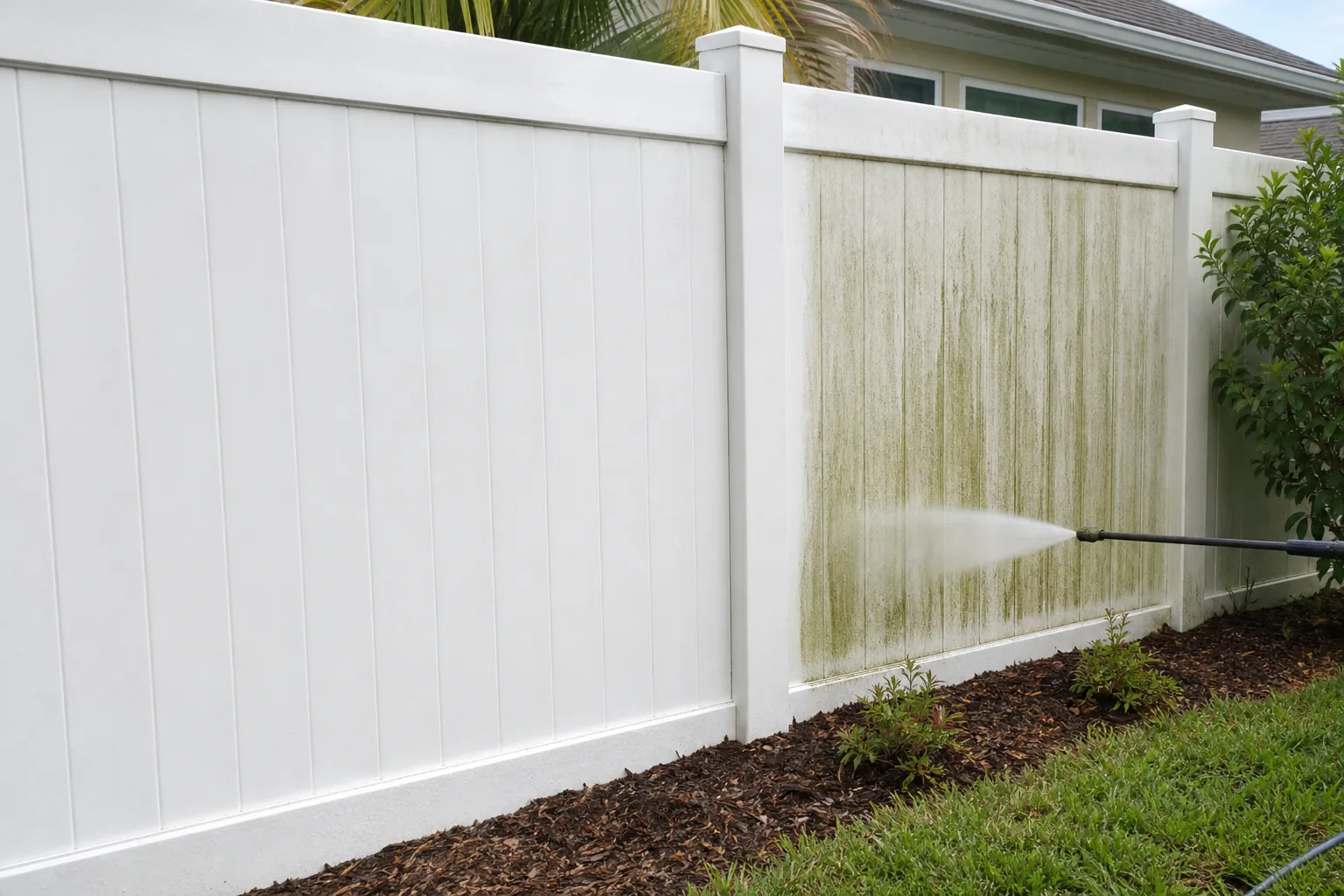
Short answer: wood fences are cleaned at 500–1,200 PSI with a wood cleaner, not blasted. Vinyl is essentially a soft wash. Priced per linear foot from $1.25 to $3.00, with both sides costing 50–70% more than one.
A fence is the surface most often ruined by enthusiasm.
It is tempting, because the results look immediate — point a narrow nozzle at grey wood and a clean stripe appears instantly. What is actually happening is that the high-pressure jet is eroding the soft spring wood between the harder grain lines. The board goes lighter because you have removed a layer of it.
That is what causes the furry, splintered texture people mistake for old wood. It is not reversible without sanding, it holds dirt worse afterwards, and it soaks up far more stain than it should — which is why some fences drink two coats and still look patchy.
Not sure what your property needs?
Send photos. We will tell you what we would do and roughly what it costs — even if the answer is that it can wait.
Wood, vinyl and composite
| Surface | Method we use | Pressure | Why |
|---|---|---|---|
| Pressure-treated pine | Wood cleaner + low pressure | 500–1,000 PSI | Soft grain erodes; the solution does the work. |
| Cedar | Wood cleaner + low pressure | 500–800 PSI | Softer still, and expensive to replace. |
| Vinyl / PVC | Soft wash | 300–800 PSI | Algae comes off chemically; pressure scars the surface. |
| Composite | Soft wash | 500–1,000 PSI | The capped layer scuffs and cannot be refinished. |
| Aluminium / wrought iron | Soft wash + hand detail | 500–1,200 PSI | Coating protects against rust; abrasion starts it. |
| Chain link | Rinse + solution | 800–1,500 PSI | Mostly about the growth on it rather than the metal. |
Vinyl deserves a specific note. Jacksonville vinyl fencing goes green on the shaded side within a couple of years, and homeowners often assume it is permanently stained. It almost never is — a soft wash normally takes it back to near-original white, because the algae is sitting on a non-porous surface rather than in it.
One side or both?
A question that catches people out when the quotes come back different.
Cleaning both sides costs 50 to 70% more than one, because it is close to two jobs — and on a shared boundary it means access to a neighbour's property, which we will not assume we have.
What is worth knowing is that the side facing away from your house is usually the dirtier one. If it faces north, or backs onto a preserve, or sits in shade all afternoon, that is where the growth is. Cleaning only your side can leave a fence that looks fine from the patio and terrible from the street.
In neighbourhoods like Julington Creek and Oakleaf, where lots are tight and fence lines are shared, neighbours quite often split a both-sides clean between them. It costs each household less than a one-side job would.
My fence is grey. Will cleaning bring the colour back?
Partly, and it depends why it is grey. Surface greying from UV and light weathering cleans up well — often surprisingly well, because most of what you are seeing is a thin oxidised layer plus organic growth.
Wood that has been grey for many years has weathered deeper than a clean will reach. A wood brightener helps considerably, and it is the step that makes the difference between "cleaner" and "restored". Beyond that, colour comes from stain, not from washing.
What fence cleaning costs
Typical Jacksonville range
$1.25–$3 per linear foot
Vinyl is quickest. Wood takes longer because pressure has to stay low enough not to raise the grain.
| Job size | Typical range |
|---|---|
| Vinyl fence, one side (100 ft) | $125–$200 |
| Wood fence, one side (100 ft) | $175–$300 |
| Wood fence, both sides (100 ft) | $275–$450 |
| Full perimeter, average Jacksonville lot (200–250 ft) | $300–$700 |
| What changes the price | Effect |
|---|---|
| Both sides instead of one | +50% to 70% |
| Heavy black mould on a shaded run | +15% to 25% |
| Prep for staining (brightener step) | +$0.50 to $1.00/linear ft |
Ranges reflect typical Jacksonville-area jobs in 2026. They are planning estimates, not quotes — the real number depends on access, buildup severity, and what the surface is actually made of. See how Jacksonville pricing works across every service →
Cleaning before staining or sealing
If you are planning to stain, tell us — the job changes.
Stain will not penetrate through algae, mill glaze or the grey oxidised layer on weathered wood. Prep cleaning uses a wood cleaner followed by a brightener, which neutralises the cleaner and opens the grain so the stain can actually absorb. It adds $0.50 to $1.00 per linear foot and it is the difference between a stain job that lasts four years and one that looks blotchy after eighteen months.
Then wait. Two to three dry days minimum before the first coat — longer in humid weather or heavy shade. Wood that looks dry on the surface is frequently still holding moisture underneath, and stain applied over it will not bond.
Areas where we do this most
Answers
Fence cleaning questions
Can you pressure wash a wood fence?
How much does fence cleaning cost in Jacksonville?
Will cleaning make my green vinyl fence white again?
Do you clean both sides of the fence?
Should I clean the fence before staining it?
What if some boards are rotten?
Related
What people usually book alongside this
Get a real number, not a range
Send a few wide shots plus close-ups of the worst areas and we will price it properly.
Or email hello@jaxpropressurewash.com
What helps us quote fast
- One wide shot of each side that needs cleaning
- Close-ups of the worst staining
- Your address, so we can check the property size
- Roughly when it was last cleaned