
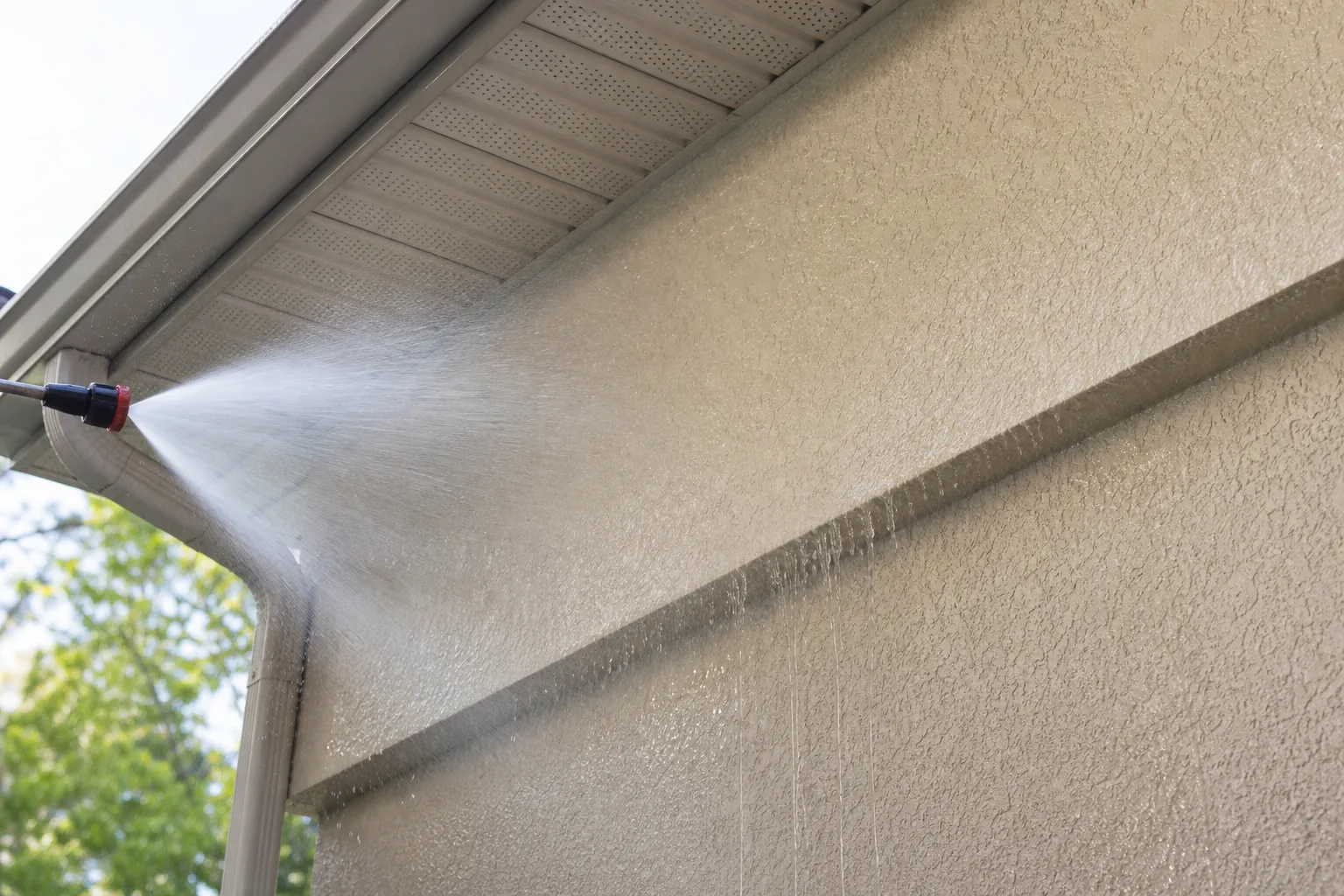
The signal: look at your north-facing wall next to a sunlit one. When you can see a colour difference between them, the algae has established and it is time. That single observation beats every interval in this article, because it accounts for your specific shade, drainage and exposure.
Every company publishes a frequency chart, and every chart is a rough average of properties that have nothing in common. A shaded bungalow in Riverside under full oak canopy and a Nocatee home on a cleared lot are not on the same schedule and never will be.
So here is both: the intervals that hold for most Jacksonville properties, and the factors that move you meaningfully off them.
Frequency by surface
| Surface | Typical interval | Sooner if | Later if |
|---|---|---|---|
| House exterior | 12 months | Heavy shade, near water, three sides under trees | Open lot, full sun, recently painted |
| Roof | 2–4 years | Overhanging branches, north slope, visible streaks | Full sun, zinc or copper strips at the ridge |
| Driveway & walkways | 12–18 months | Shaded slab, oak litter, irrigation overspray | Sunny, sealed, low traffic |
| Gutters (clearing) | 6 months | Pine overhead — every 4 months | Nothing overhead — annually |
| Pool deck | 12 months | Shaded, screened, backs onto preserve | Open, sunny, sealed |
| Screen enclosure | 12 months | Backs onto preserve or under canopy | Street-facing, open exposure |
| Fence | 12–24 months | North-facing run, shaded, wood | Vinyl in full sun |
| Deck | 12 months | Shaded, walked barefoot, going slippery | Composite, sunny, covered |
| Windows | 6–12 months | Sprinkler overspray hitting the glass | Sheltered, no irrigation nearby |
| Paver sealer | Reseal 2–3 years | Full sun, vehicle traffic, coastal | Shaded patio, foot traffic only |
| Solar panels | 12 months | Under trees, coastal, bird activity | Open roof, steep pitch that sheds well |
| Dock | 12 months | Shaded tidal creek, heavy growth | Open water, good airflow |
The four things that actually move the interval
In order of how much difference they make.
- Shade. By some distance the biggest factor. Algae needs moisture, and shade is what stops a surface drying. A wall that gets four hours of direct sun behaves completely differently from one that gets none.
- Tree cover directly overhead. Not the same as shade. Canopy drops organic litter — leaves, pine straw, catkins, acorns, sap — which feeds growth and blocks gutters. A house in shade from a building ages far better than one under an oak.
- Water. Proximity to the river, a creek, the Intracoastal or the ocean raises ambient humidity year-round. Irrigation does the same thing locally, and adds mineral staining on top.
- Surface porosity. Stucco holds growth in its texture; vinyl sheds it. Two identical houses on the same street with different siding are not on the same schedule.
Notice what is not on that list: how old the house is, and how much you paid for it. Neither predicts anything.
The Jacksonville calendar
Some months are genuinely better than others here, and one is genuinely bad.
| Time of year | Good for | Watch out for |
|---|---|---|
| Jan–Feb | Roof cleaning, quiet scheduling, better rates | Cool nights slow solution activity |
| Mar–mid Apr | Almost nothing | Peak oak pollen — anything washed now needs washing again |
| Late Apr–May | The best window of the year for everything | Books up fastest; plan ahead |
| Jun–Aug | Flatwork, commercial, early-morning work | Afternoon storms, solution flashing off hot surfaces |
| Sep–Oct | Second-best window; post-storm cleanup | Hurricane season debris |
| Nov–Dec | Pre-holiday curb appeal, listing prep | Busy stretch before Thanksgiving |
Why is March such a bad time to wash a house here?
Live oaks in Jacksonville drop catkins and release pollen through March into early April, and they do it heavily. A house washed in the middle of that will have a fresh yellow-green film on it within two weeks.
If your HOA has sent a notice with a March deadline, that is a different matter — clean it, and understand you may want a light rinse afterwards. Otherwise, wait until the drop has finished. The last week of April is usually safe.
Should I clean before or after hurricane season?
After, for anything driven by appearance. Cleaning in June and then taking a storm in September means paying twice.
The exception is gutters, which should be cleared before the season starts. A blocked gutter during a tropical downpour puts water where you do not want it, and that is a repair rather than a cleaning problem.
Why annual costs less than every four years
This is the part that surprises people, so here are the actual numbers.
Organic growth builds root structure into porous surfaces over time. A year of algae sits near the surface and rinses off with a standard mix and a single pass. Four years of algae has worked into the pores of stucco or concrete and needs a stronger solution, longer dwell, and frequently a second application — which is why first-time cleans are quoted 15 to 30 percent above maintenance rates.
Annual maintenance on a typical Jacksonville home runs about $300 a year. Letting it go four years and then fixing it costs closer to $600 in one visit — and in the meantime you have had four years of a living organism working on the surface.
The same logic applies more sharply to roofs. There, the growth is not just unsightly; it is consuming the limestone filler in your shingles.
Intervals differ by area — see yours
Answers
Timing questions
How often should you power wash a house in Florida?
What is the best time of year to power wash?
How often should a roof be washed?
What time of year is best for roof cleaning?
Is it worth washing every year, or should I wait until it looks bad?
Does washing more often damage anything?
Related
Where to go next
Not sure if yours is due?
Send a photo of your north-facing wall. We will tell you honestly whether it needs doing now or can wait another season.