
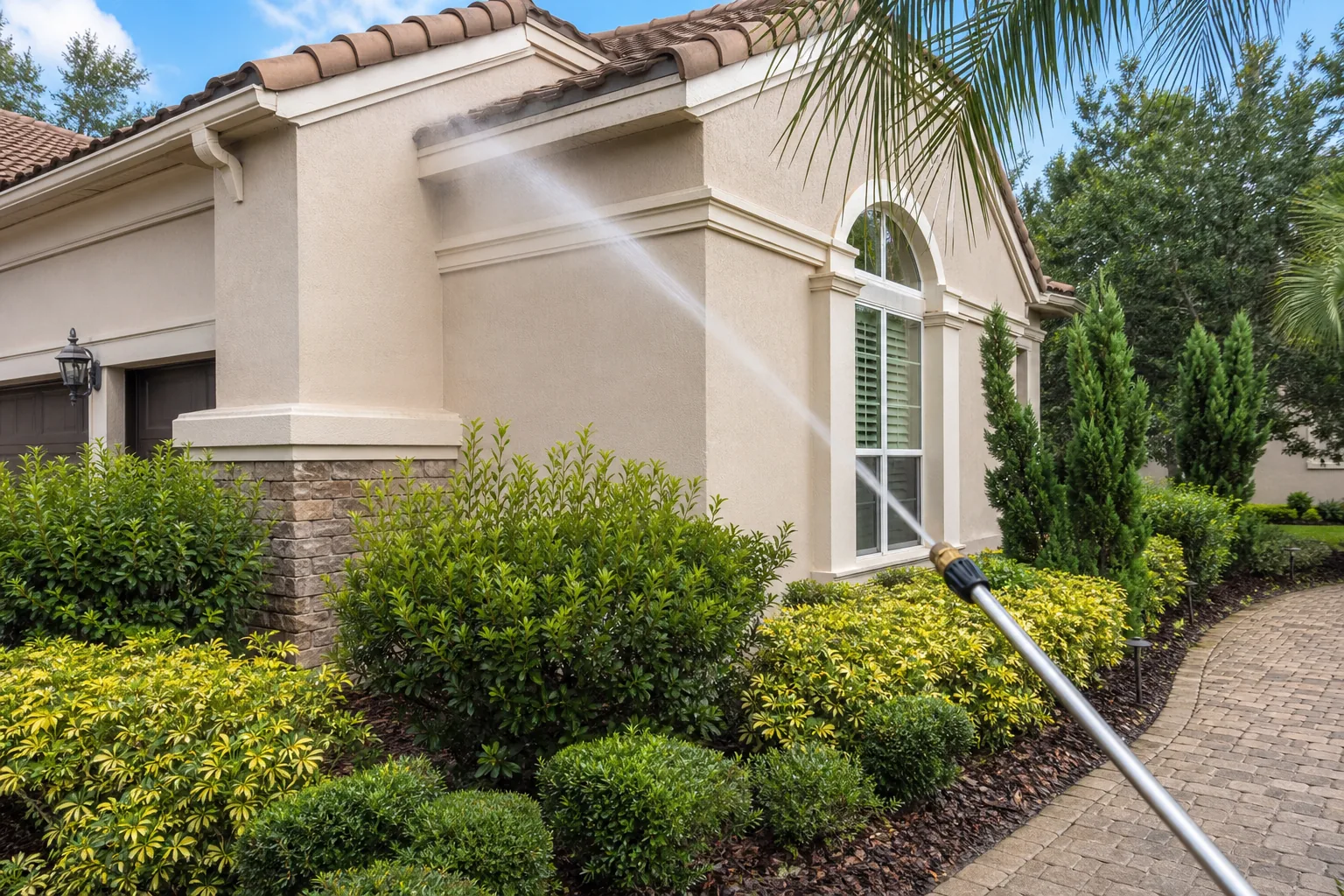
What Jacksonville Beach properties need most: Salt crystallises on every horizontal and windward surface, holds moisture, and corrodes fasteners, light fixtures and metal roof seams. Rinsing salt off is a maintenance task, not a cosmetic one.
Standing-seam metal roofs are common near the ocean and they need a rinse-and-treat approach, never a scrub. Older beach cottages often have cedar or Hardie siding that has gone chalky from UV, and that has to be tested before any solution goes on it. Sand in the driveway joints is its own separate nuisance.
Why Jacksonville Beach properties get treated differently
These are the details that decide which method, which pressure and which solution strength a property gets. They are not the same across Jacksonville.
Housing built
1950–2020, heavily mixed
Exterior walls
Hardie board, stucco, vinyl, some cedar
Roof materials
Metal, architectural shingle
Tree cover
Light
ZIP codes
32250
County
Duval
Shade: Open exposure means sun and pollen matter more than shade does. Full salt exposure — it settles on every windward surface and holds moisture against it.
Water supply: Municipal supply, so irrigation rust is less common than in Clay County.
Community rules: Some communities have appearance covenants; most owners book on their own schedule.
We also work regularly around the Jacksonville Beach Pier, Beach Boulevard, Third Street. Those are geographic reference points only — no affiliation or endorsement is implied.
Most booked here
What Jacksonville Beach customers actually call about
How often Jacksonville Beach properties need it
Adjusted for light tree cover and high salt exposure. The Jacksonville average is in brackets for comparison.
| Surface | Jacksonville Beach interval | Jacksonville average |
|---|---|---|
| House exterior | 11–15 months | 12–16 months |
| Driveway & walkways | 13–17 months | 12–18 months |
| Roof | 3–5 years | 2–4 years |
| Gutters | Annually | Twice a year |
| Windows | 6–12 months | 6–12 months |
Common questions from Jacksonville Beach homeowners
When is the best time of year to book in Jacksonville Beach?
Late spring, once the oak pollen has finished falling — usually the second half of April here. Washing before pollen season ends means doing it twice.
Being this close to the ocean, there is a second consideration: salt builds year-round rather than seasonally, so a lot of Jacksonville Beach owners rinse in autumn as well, particularly on windward elevations and metal fixtures.
How often will my Jacksonville Beach home need it?
Open exposure works in your favour — twelve to eighteen months is realistic for most Jacksonville Beach homes. The limiting factor here is pollen and sun-baked residue on the south and west walls rather than algae.
The reliable signal is a visible colour difference between the shaded elevation and the sunny one. Full frequency guide by surface.
Does living near the ocean really change anything?
More than most people expect. Salt is hygroscopic — it pulls moisture out of the air and holds it against whatever it has settled on. A salt-loaded wall stays damp longer than a clean one, and damp surfaces grow algae faster.
It also attacks fixtures, fasteners, light fittings and metal roof seams long before it does anything visible to the walls. A rinse is genuinely maintenance here, not just appearance. See our guide to salt air and coastal exteriors.
Answers
Questions from Jacksonville Beach
Do you service all of Jacksonville Beach?
What is the most common exterior problem in Jacksonville Beach?
How much does pressure washing cost in Jacksonville Beach?
How soon can you get out to Jacksonville Beach?
Do I need to be home?
Get a price for your Jacksonville Beach property
Send a few photos and your address. Most estimates go back the same day, with anything that could change the number flagged up front.